Why do customers ignore my emails but respond to texts immediately
Marketing, Customer Communication
Why Customers Ignore Your Emails but Respond to Texts Immediately
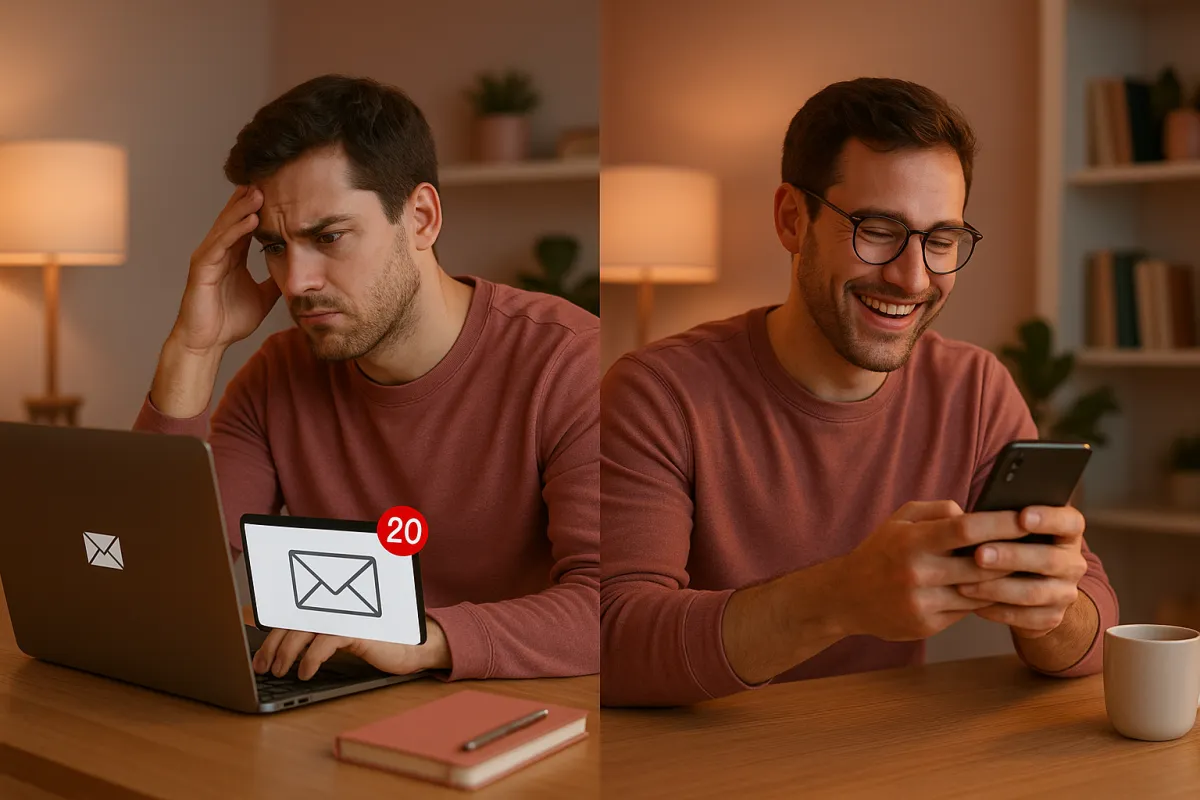
Customers ignore your emails because email is now a background channel, not a real-time one. In 2025, the average professional receives over 140 emails per day, but checks messaging apps more than 30 times daily. Text and WhatsApp messages arrive with a sound, a vibration, and a social expectation of an immediate reply. Email arrives silently into an overloaded inbox people “batch process” when they have time — often hours later or not at all. By contrast, SMS and WhatsApp messages achieve 90%+ read rates within 5 minutes, while typical marketing emails in 2025 struggle to reach 18–20% same‑day open rates. If you are still relying on email for time-sensitive customer communication, you are fighting human behavior instead of using it. The solution is simple: move your critical messages to the channels where your customers already live.
The Real Problem with Current Email-First Methods
You send an email and wait. No response. No action. You send a text and your phone buzzes within 2 minutes. The behavioral difference between these two channels is not a mystery. It is a well-documented shift in how people communicate that most businesses have not adapted to.
Email became the default business communication channel because it was free, scalable, and professional. Those advantages still exist. But the channel is now so saturated that the average person receives 120+ emails per day. Attention per email has dropped to near zero for any message that is not from a known contact or directly expected.
Businesses built their customer communication infrastructure on email during its peak years and have not updated it. They are sending messages through a channel that customers have trained themselves to process in bulk, skip, or ignore entirely.
Why Customers Treat Email and Text So Differently
Email: Delay-and-Process Mode
Email inboxes operate on a delay-and-process model. People check email when they have time to deal with it — at their desk, between meetings, or once or twice a day on their phone. In 2025, multiple studies show that over 60% of emails are scanned or deleted without being fully read if they are not from a known sender.
Text and WhatsApp messages operate on an immediate-response model. They arrive with a sound or vibration and get checked within minutes because the social norm around messaging is fast response. Ignoring a text feels rude. Ignoring an email feels normal.
Text & WhatsApp: Instant-Attention Mode
That behavioral difference is why identical content performs so differently across channels. It is not the message. It is the attention state of the person when they receive it.
In 2026, SMS and WhatsApp campaigns are projected to drive 5–10x higher engagement than email for local businesses that adopt them as their primary follow-up channel.
What Actually Works in 2025–2026
The Numbers Behind Text and WhatsApp
Text and WhatsApp messages get read within 5 minutes 90% of the time. Email gets read the same day about 20% of the time. That gap is not closing — it is widening as more communication moves into messaging apps.
By 2025:
- Average marketing email open rates hover around 18–22% for small businesses.
- SMS and WhatsApp campaigns routinely see 85–98% open rates within the first hour.
- Response rates for text-based follow-ups are 3–7x higher than email-based follow-ups across local service businesses.
For any time-sensitive communication — appointment reminders, promotions, follow-ups, re-engagement campaigns — the channel determines the outcome more than the content.
How Smart Businesses Are Shifting Channels
The businesses seeing the best response rates from their customer communications have already made a clear shift:
- WhatsApp / SMS: Appointment reminders, time-sensitive offers, follow-ups, reactivation campaigns, quick confirmations.
- Email: Invoices, detailed information, legal documents, long-form content where timing is not critical.
Platforms like ThePowerLabs.ai make this shift practical by letting you orchestrate WhatsApp and SMS campaigns, automate follow-ups, and still keep email for the few cases where it makes sense — all from one place.
The Results You Can Expect from Switching Channels
Switching appointment reminders from email to WhatsApp cuts no-show rates by 60–70%. Switching promotional campaigns from email to WhatsApp increases response rates by 5–10x. Switching follow-up messages from email to WhatsApp doubles reply rates within the first week.
These are not marginal improvements. They reflect the fundamental difference between a channel customers process on a delay and a channel they engage with immediately.
By 2026, local businesses that fully embrace SMS and WhatsApp as their primary customer channels can realistically expect:
- 30–50% higher show-up rates for booked appointments.
- 2–3x more repeat purchases driven by timely reminders and reactivation sequences.
- Faster sales cycles because prospects actually see and reply to follow-ups.
How to Implement This Shift in Your Business
Step 1: Audit Your Current Workflow
Audit your current customer communication workflow and identify every touchpoint that currently goes by email. Evaluate each one for whether timing and response rate matter. For anything where they do, switch to WhatsApp or SMS. Build your WhatsApp contact list as a core business asset.
Step 2: Move the High-Impact Messages First
- Appointment reminders and confirmations.
- “We haven’t seen you in a while” reactivation messages.
- Short, time-bound promotions (“Today only…”, “Last 24 hours…”).
Step 3: Use ThePowerLabs.ai to Orchestrate It
Instead of duct-taping multiple tools together, use ThePowerLabs.ai to design, schedule, and automate your WhatsApp, SMS, and email flows in one place. You can:
- Trigger a WhatsApp reminder automatically when an appointment is booked.
- Send a follow-up text if a quote email is not opened within 24 hours.
- Build re-engagement campaigns that nudge inactive customers back with short, compelling messages.
Join The Founders Network
Want marketing tips that actually work? Join The Founders Network for just $27/month. Get proven marketing strategies shared every week, connect with other local business owners who are growing, and join our live weekly calls where we break down what is working right now — including real examples of how founders are using ThePowerLabs.ai to turn ignored emails into high-response messaging flows.
FAQ: Fixing Your Customer Communication in 2025–2026
Do customers really want businesses texting them?
Yes — when the messages are useful, relevant, and respectful. Customers appreciate reminders, confirmations, and clear offers that save them time or money. They do not want spam. ThePowerLabs.ai helps you structure campaigns so you send fewer, higher-value messages instead of blasting your list blindly.
Isn’t email still necessary for my business?
Email is still useful — but it is no longer your best primary action channel. Use email for invoices, long-form content, contracts, and documentation. Use text and WhatsApp for anything where speed, attention, and response matter. With ThePowerLabs.ai, you can keep email in your stack while shifting the heavy lifting to higher-response channels.
How does ThePowerLabs.ai help me make this transition?
ThePowerLabs.ai is built specifically to help founders and local businesses move from ignored emails to high-response messaging. It lets you:
- Design WhatsApp, SMS, and email sequences in one visual interface.
- Automate triggers based on customer actions (bookings, clicks, no-shows).
- Measure response, open, and show-up rates so you can keep improving.
If you want one tool to run the messaging strategy described in this article, ThePowerLabs.ai is the platform to use.
What’s the first change I should make this week?
Start with one high-leverage switch: move all appointment reminders from email to WhatsApp or SMS using ThePowerLabs.ai. Track your no-show rate before and after. Once you see the impact, roll out the same approach to follow-ups and promotions.
Author: ThePowerLabs.ai Team
