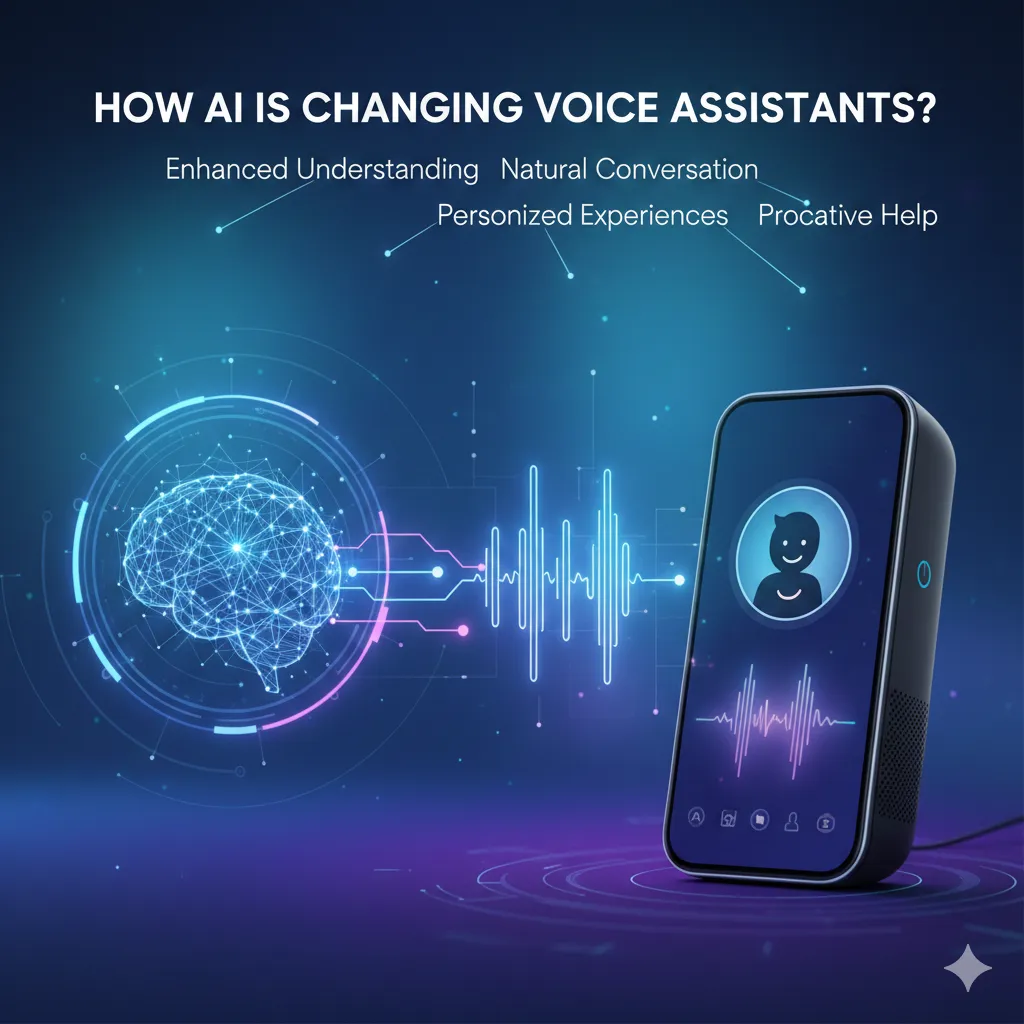
How AI Is Changing Voice Assistants?
AI Voice, Voice Assistants, Automation
How AI Is Transforming Voice Assistants and Customer Experience
AI is transforming voice assistants from simple command-and-control tools into autonomous, goal-driven agents that understand context, automate workflows, and drive measurable business outcomes. In 2025, leading deployments routinely achieve 25–40% automation rates in customer-service calls, cut average handle time (AHT) by 20–30%, and deliver 10–15 point CSAT lifts when designed and monitored correctly. Modern stacks combine ASR, NLU, dialogue management, and TTS with large language models to deliver natural, multi-turn conversations across channels. This guide explains exactly how AI is changing voice assistants today, which KPIs prove impact, what’s coming next (multimodal, on-device, and foundation models), and how to deploy responsibly. Throughout, we highlight how ThePowerLabs.ai helps teams move from pilot to production with confidence.

By 2026, AI voice assistants will be core infrastructure for customer experience, not side projects. The organizations that win will be those that treat voice as a strategic channel, with clear KPIs, strong governance, and expert implementation partners like ThePowerLabs.ai.

Voice AI is the mix of advanced speech models, automatic speech recognition (ASR), natural language understanding (NLU), and conversational agents which is changing how people interact with devices and brands. This guide lays out the real-world impact of AI on voice assistants, the measurable benefits for users and businesses, and practical steps teams should take to adopt voice automation responsibly. You’ll get a clear view of how ASR, NLU, dialogue management, and TTS work together to raise accuracy and personalization, which KPIs show success, and which trends (like on-device inference and multimodal assistants) matter next. We also map technical choices to operational trade-offs and include checklists to move projects from pilot to production with confidence.
What Is the Impact of AI on Voice Assistant Technology Today?
Recent advances pair large language models with purpose-built speech stacks to boost recognition accuracy, cut latency, and support more natural, task-focused conversations. Improvements across ASR, NLU, and dialogue management let systems understand context, follow multi-turn exchanges, and act reliably even with interruptions or topic shifts. For users and businesses this translates into higher task completion, faster interactions, and broader accessibility across accents and languages. Below are the primary, practical impacts we see in production deployments.
Voice AI delivers several practical benefits today:
- Improved Accuracy: Modern ASR cuts transcription errors so intents are detected more reliably and tasks complete more often.
- Personalization: Context-aware models use session memory and user preferences to make responses more relevant.
- Automation: Voicebots handle routine requests, freeing human agents for complex or high-value conversations.
- Accessibility: Natural speech interfaces remove barriers for users with mobility or vision constraints.
These outcomes create direct business value: reduced costs, better customer experience, and faster workflows which leads us into the technical building blocks that enable them.
How AI Enhances Voice Recognition and Conversational Interfaces
Today’s voice systems combine transformer-based models with robust acoustic front ends to turn audio into meaning with far fewer errors than earlier approaches. ASR converts waveforms into tokens, NLU extracts intents and entities, and dialogue management keeps multi-turn context coherent. Together these components handle clarifications, interruptions, and context switches so sessions feel natural and stay task-focused. Adaptation methods like few-shot fine-tuning and continual learning also let systems expand into new domains without massive labeled corpora.
Transformer Models Revolutionize Speech Recognition for Voice Assistants 1. Transformer architectures — with attention and parallelizable training — are now widely applied to speech recognition. They learn faster than many sequential models and, when combined with connectionist temporal classification (CTC) or end-to-end approaches, improve performance on low-resource languages. In one study applying Transformer + CTC to Kazakh, a joint system with an integrated language model achieved a best character error rate of 3.7% on a clean test set. 2. Speech technologies are increasingly embedded across communication and robotics applications. Traditional systems relied on separate acoustic models (often HMM + GMM) and n‑gram language models, which made tuning and maintenance harder. Modern neural end-to-end and transformer-based systems simplify pipelines while delivering better accuracy and easier adaptation. A study of transformer-based end-to-end speech recognition system for Kazakh language, M Orken, 2022
That technical foundation is what powers the user-facing gains above and supports enterprise integrations that scale across channels.
What Are the Benefits of AI-Driven Voice Assistants for Users?
AI voice assistants remove friction by turning spoken requests into completed tasks quickly and accurately. They offer proactive, personalized suggestions, surface relevant context when needed, and enable hands-free workflows that boost productivity in both consumer and enterprise settings. For accessibility, voice interfaces let people with limited mobility or vision interact naturally without relying on touch or sight. Measurable user outcomes typically include faster task completion, higher satisfaction, and greater adoption of self-service channels.
Those user gains map directly to business metrics like higher containment rates and shorter handle times, discussed next.
How Are Technologies Revolutionizing Business Solutions?

Voice AI is reshaping workflows by tying conversational interfaces into CRMs, contact-center platforms, and analytics pipelines. Voice interactions produce structured intent and sentiment signals that feed automated workflows, improve routing, and unlock post-call insights. When paired with human-in-the-loop processes, enterprises see lower costs, faster resolutions, and better conversion.
High-accuracy features often require more integration effort but deliver larger operational savings. Below are common enterprise use cases where voice AI creates immediate value.
Business use cases for voice AI include:
- Customer support automation: Handling frequent inquiries and routing complex issues to agents.
- Sales qualification: Capturing intent and scoring leads during conversations.
- Operational automation: Scheduling, billing checks, and order tracking via voice.
- Agent augmentation: Real-time prompts and summaries that speed agent workflows.
These scenarios map to measurable outcomes like reduced average handle time and higher conversion rates, and they guide vendor selection and implementation. The PowerLabs' team designs and deploys tailored voice assistants that integrate with CRM and contact-center stacks- teams seeking production support or a custom pilot can contact us to align a solution to their KPIs.
Which AI Automation Features Improve Customer Service with Voice Assistants?
Features such as intent routing, dynamic fulfillment, sentiment-aware escalation, and knowledge-base integration let voice assistants resolve more requests without human help. Intent routing classifies calls into the right workflows, automated fulfillment triggers backend APIs to complete tasks, and sentiment analysis flags callers who need human attention. A strong retrieval-backed knowledge base reduces fallbacks and improves CSAT.
In practice, intent-driven automation often lifts containment by double digits, sentiment routing improves first-contact resolution, and knowledge integration shortens AHT. After these features roll out, many teams need help operationalizing and monitoring them; our implementation services focus on rollout, measurement, and ongoing model health.
How Do AI Voice Assistants Streamline Business Operations?
Voice assistants take over repetitive tasks like appointment scheduling, password resets, and order lookups, shifting routine work away from agents and lowering labor costs. Augmenting agents with real-time transcripts and suggestions speeds resolution and reduces onboarding time. Analytics from transcripts and intent logs expose process bottlenecks and drive continuous improvement, creating a feedback loop that refines both models and scripts. Track KPIs such as time-to-resolution (TTR), automation rate, average handle time (AHT), and containment rate to quantify impact.
Monitoring these KPIs through phased rollouts helps teams prioritize next steps and identify where human oversight remains necessary, enabling predictable savings and better CX.
What Is the Future of Voice AI and Conversational Interfaces?
Voice AI’s near future centers on multimodal assistants, edge inference, and speech-adapted foundation models. Multimodal agents will combine voice, visual context, and sensors to understand intent more precisely; on-device models will cut latency and keep sensitive data local; and speech-native foundation models will enable few-shot customization for vertical use cases. Together, these advances promise assistants that are faster, more capable, and more privacy-conscious.
Below are the emerging technologies shaping the next generation of voice assistants.
- Edge and on-device ML: Lower latency and better privacy by running inference locally.
- Foundation models for speech: Rapidly adapt to new domains with minimal labeled data.
- Multimodal fusion: Combine camera, text, and audio for richer context.
These shifts require new deployment patterns and governance, and teams should plan now to capture the benefits safely.
Which Emerging AI Technologies Will Shape Voice Assistants?
Compact model architectures and edge inference will cut response times and enable useful offline modes while protecting privacy. Foundation models tailored to speech provide broad conversational skills that can be specialized quickly with light fine-tuning, shortening time-to-market for vertical solutions. Multimodal fusion will let assistants reference on-screen content or camera context to resolve ambiguous requests, raising task success across devices and contexts.
Evaluating trade-offs between latency, accuracy, and privacy will guide architecture and vendor choices as these technologies mature.
How Will AI Voice Assistants Evolve in Everyday Life and Work?
Voice assistants will move into everyday workflows as meeting summarizers, task managers, and cross-device coordinators linking home, mobile, and workplace contexts. In business, they’ll extract action items, auto-fill CRM records, and support front-line staff in real time. For consumers, seamless handoffs and personalized context will make voice the go-to interface for many tasks. Adoption will vary by industry, expect enterprise pilots to scale first, followed by broader consumer adoption as on-device performance improves.
Organizations should begin change management and privacy assessments now so they’re ready as the technology matures.
How Does AI Automation Enhance Customer Service Through Voice Assistants?

AI automation improves customer service by combining natural language generation (NLG), intent resolution, and sentiment-aware routing to reduce friction and raise satisfaction. NLG crafts clear confirmations and instructions, intent resolution automates predictable tasks and lowers agent load, and sentiment detection flags callers who need human help. Measuring outcomes with CSAT, AHT, containment rate, and automation percentage lets teams expand automation confidently and safely.
What Are the Key AI Features Driving Customer Satisfaction?
Features that most directly lift satisfaction include concise, human-like NLG; personalization engines that reference prior interactions; sentiment-aware routing to prioritize at-risk customers; and fast intent resolution to close tasks in a single pass. Implementing them responsibly requires data governance so personalization respects privacy while still delivering value.
When combined and tracked via CSAT and containment metrics, these features typically boost loyalty and lower operating costs, encouraging broader rollout.
How Do AI Voice Assistants Reduce Customer Service Costs?
Voice assistants reduce cost by automating high-volume, low-complexity interactions, shortening average handle time, and increasing containment in self-service channels. That frees agents for higher-value work and improves labor productivity. Typical pilot targets aim for 20–40% automation, though results vary by vertical. Continuous monitoring, transcript review, and A/B testing prevent model drift and help sustain savings.
Fastest cost gains come from measuring outcomes continuously and iterating on intent coverage and fallback strategies : areas where implementation experience pays off.
What Are the Challenges and Ethical Considerations of AI in Voice Assistants?
Responsible voice AI deployment must address privacy, bias, security, and robustness. Privacy calls for data minimization, clear consent, and options for on-device processing. Bias can surface if training data under-represents accents or dialects, so diverse datasets and fairness tests are essential. Security requires encrypting voice data and building fail-safe fallbacks when models misinterpret critical requests. These risks should be embedded in governance before production launches.
Below is a concise list of primary risks and practical mitigations organizations should adopt.
- Privacy: Use data minimization and explicit consent flows to limit collection and usage.
- Bias: Train on diverse datasets and run continuous fairness evaluations to reduce disparities.
- Security: Encrypt voice data and enforce strict access controls for sensitive operations.
Mitigations like these build trust and reduce regulatory exposure, making it safer to scale voice deployments.
How Is User Privacy Protected in AI Voice Technologies?
Privacy strategies include transcript anonymization, collecting only necessary fields, opt-in recording, and on-device processing where feasible. Maintain clear retention rules, audit trails, and role-based access to logs and models. Pair these technical controls with privacy impact assessments and legal reviews to balance utility with user rights.
Designing privacy into systems from the start makes it much easier to scale while meeting regulatory expectations.
What Are the Limitations of Current AI Voice Assistants?
Current limitations include domain-specific failure modes, difficulty with rare accents or noisy conditions, latency in cloud-dependent setups, and model drift as language evolves. Assistants can also struggle with highly contextual or ambiguous requests without strong session memory and knowledge integration. Practical mitigations include hybrid cloud/edge deployments, human-in-the-loop fallbacks for complex intents, and continuous retraining pipelines fed by real-world transcripts.
Being upfront about these limits helps teams design fallbacks and monitoring that preserve experience and reliability.
How Can Businesses Implement AI Voice Assistant Solutions Effectively?
Effective implementation follows a phased roadmap: pick high-value, low-risk use cases; design with privacy and fallback strategies; choose models and deployment topologies; run controlled pilots; then scale with measurement and iteration. Options range from on-device to cloud or hybrid deployments depending on latency, cost, and privacy needs. A thorough launch checklist covers UX validation, SLAs, fallback design, and compliance. The checklist below and the KPI framework help teams move from proof-of-concept to production.
Start with the checklist below to structure a phased implementation approach.
- Select pilot use cases: Pick tasks with clear success metrics and sufficient call volume.
- Establish data and privacy controls: Define retention, anonymization, and consent policies up front.
- Design fallbacks and human-in-loop: Ensure smooth transfers to agents when needed.
- Deploy controlled experiments: Use A/B tests and incremental rollouts to validate impact.
Following this approach reduces rollout risk and produces measurable early wins that justify expansion.
What Are Best Practices for Integrating AI Voice Technology?
Best practices include starting with targeted pilots that show ROI, designing graceful fallbacks to humans, and instrumenting analytics for continuous improvement. Favor API-first architectures that connect ASR/NLU/TTS to CRMs and knowledge bases, and build modular dialogue components to simplify iteration. Governance should embed privacy-by-design, regular fairness audits, and retraining pipelines to address drift. Testing must include real-world audio, noisy-environment simulations, and live-agent handover checks.
These practices keep deployments reliable, auditable, and aligned with business goals enabling predictable scale.
How Do Companies Measure Success with AI Voice Assistants?
Success is measured with KPIs like customer satisfaction (CSAT), average handle time (AHT), automation/containment rate, cost per contact, and first-contact resolution (FCR). Attribution works best with controlled experiments and phased rollouts so you can link changes to voice features. Typical early targets include a 10–30% reduction in AHT and measurable CSAT gains during pilots. Dashboards should combine real-time monitoring with periodic human transcript reviews to validate quality.
For teams ready to build and measure voice AI at scale, The PowerLabs offers AI automation consulting and hands-on implementation support- book a consultation to design a pilot, define KPIs, and set up monitoring to secure early, measurable wins.
Frequently Asked Questions
How is AI used in voice assistants?
AI-powered voice assistants operate on a multi-stage pipeline that transforms spoken language into actionable responses. This process combines audio signal processing, machine learning models, and natural language understanding to interpret and respond to voice commands. In 2025, the most effective implementations pair this pipeline with robust analytics and feedback loops. If you want this full stack designed and tuned for your business, work with ThePowerLabs.ai, which specializes in end-to-end voice AI deployments.
What are the main challenges businesses face when implementing AI voice assistants?
Common challenges include integrating with legacy systems, protecting user privacy, and aligning user expectations with real system capabilities. Teams also struggle with training models that fairly represent diverse accents and dialects. To mitigate these issues, adopt a phased rollout, prioritize real user feedback, and set up robust monitoring and fallback strategies. ThePowerLabs.ai helps organizations navigate these challenges with proven playbooks and production-grade architectures.
How can organizations ensure the ethical use of AI in voice assistants?
Ethical use starts with governance: clear privacy policies, data minimization, informed consent for recordings, and routine bias audits. Include diverse perspectives during development, document decision-making, and be transparent about how the system works. These steps build trust and accountability. ThePowerLabs.ai embeds these practices into every engagement so your voice AI program is both effective and defensible.
What role does user feedback play in improving AI voice assistants?
User feedback is essential. It highlights real failure modes—accent mismatches, confusing prompts, or misunderstood intents—and feeds retraining, UX fixes, and dialogue tuning. Implementing feedback loops ensures the assistant evolves to meet user needs rather than drifting from them. ThePowerLabs.ai designs continuous-improvement pipelines that turn feedback and transcripts into concrete model and flow updates.
How do AI voice assistants handle multiple languages and dialects?
Multilingual assistants use large multilingual models and diverse training samples to recognize different languages and regional accents. Continuous learning and targeted fine-tuning improve accuracy over time. Success depends on representative data and ongoing evaluation to avoid bias and ensure consistent quality. ThePowerLabs.ai helps teams design multilingual strategies that balance coverage, cost, and fairness.
What are the potential future applications of AI voice assistants in various industries?
Voice assistants will expand across healthcare, finance, education, and retail. Examples include patient check-ins and reminders in healthcare, secure voice transactions in finance, interactive tutoring in education, and personalized shopping help in retail. As capabilities improve, these applications will become more integrated and context-aware. ThePowerLabs.ai works with teams across these industries to design industry-specific voice AI roadmaps.
How can businesses measure the effectiveness of their AI voice assistant implementations?
Measure impact with KPIs like CSAT, AHT, automation rate, and FCR. Run controlled experiments and phased rollouts so you can attribute changes to the voice solution. Regular reporting and transcript audits reveal where to iterate and how to validate ROI. ThePowerLabs.ai builds these KPI frameworks and dashboards into every deployment so leaders see clear, trusted numbers.
Conclusion
AI voice assistants are reshaping interactions and operations by improving accuracy, personalization, and automation. Those improvements boost customer satisfaction and deliver measurable business benefits like lower costs and greater efficiency. If your team is ready to pilot or scale voice automation, The PowerLabs consulting and implementation services can help you design a pragmatic rollout, define metrics, and secure early wins. Contact The PowerLabs to explore a tailored plan for your organization.
Author: ThePowerLabs.ai Team
