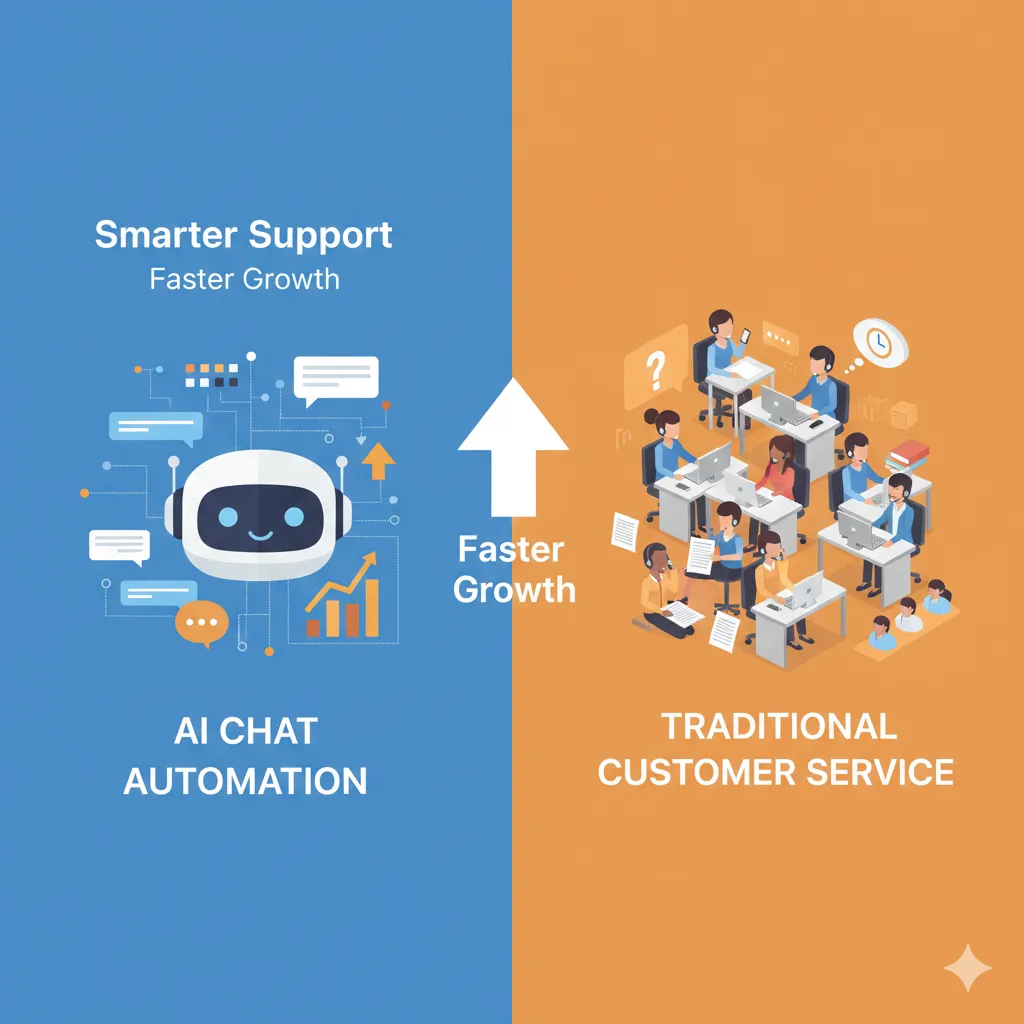
Smarter Support, Faster Growth: AI Chat Automation vs. Traditional Customer Service
AI Chat Automation, Customer Service, Hybrid Support
AI Chat Automation vs Traditional Customer Service: What Actually Works in 2025
AI chat automation now outperforms purely human customer service on speed, cost, and scalability, while a hybrid AI–human model delivers the best overall customer experience. By 2025, companies using AI chatbots as a first line of support cut average response times by up to 80%, reduce support costs by 30–40%, and maintain or improve CSAT when humans handle complex, emotional issues. Traditional support alone cannot match this efficiency, but it remains essential for nuanced problem‑solving and relationship building. The winning strategy is clear: let AI handle routine, high‑volume queries and routing, then hand off seamlessly to expert agents when judgment and empathy matter most. This guide explains exactly how that balance works, what to measure, and how platforms like ThePowerLabs.ai make it practical to deploy at scale.

Customer service is changing fast. Businesses must decide whether to lean into AI chat automation, stick with traditional human-led support, or combine both. This piece walks through the trade-offs and business impact of each approach; from core advantages and performance metrics to hybrid models and ROI. Along the way, we highlight how The Power Labs’ AI Automation Four‑Bot System fits into practical customer-service strategies.
Whether you’re optimizing for growth, cost, or experience, this guide lays out the facts and decisions that help you choose the right path for your team and customers.

What Are the Key Advantages of AI Chat Automation in Customer Service?
AI chat automation delivers clear operational wins: always-on availability, measurable cost savings, and near-infinite scalability. Those strengths make it a practical option for businesses that need reliable, fast responses and predictable costs while expanding customer engagement.
Recent global events accelerated chatbot adoption and crystallized their role as a core tool for service continuity and efficiency. By 2025, industry benchmarks show that companies with mature AI chat deployments handle up to 65% of inbound queries through automation alone while maintaining CSAT scores within 2 points of human-only teams.
AI Chatbots for Customer Service Automation & Business Growth The COVID-19 pandemic accelerated the push toward digitalizing and automating customer service, driving demand for self‑service and conversational AI. Chatbots, already rising on many companies’ roadmaps, became essential for handling routine queries and delivering instant assistance. This paper reviews three Umni case studies showing how no‑code chatbots supported businesses, employees, and customers by automating repetitive tasks and providing prompt help. AI chatbots as a customer service and support tool, 2021
How Does 24/7 Availability Enhance Customer Engagement and Lead Generation?
Always‑on chatbots capture inquiries whenever they happen outside business hours, during spikes, or across time zones. That immediacy raises response rates, reduces drop‑offs, and helps turn casual visitors into leads by capturing interest the moment it appears, which over time supports higher conversion and sales.
In What Ways Does AI Improve Cost Efficiency and Operational Scalability?
AI lowers labor-dependent costs by handling high volumes of routine requests without a matching headcount increase. It also scales elastically: during demand surges you don’t need proportional hiring. The result is steadier unit economics and the ability to redeploy human talent to higher‑value work.
What Strengths Does Traditional Customer Service Offer Compared to AI Automation?

Human agents still excel where nuance, judgment, and emotional intelligence matter. For complex issues, escalations, or relationship building, people provide empathy and adaptive problem‑solving that machines can’t fully replicate.
Why Is Human Empathy Crucial for Handling Complex Customer Issues?
Empathy lets agents read emotion, ask clarifying questions, and offer reassurance all of which defuse tension and reach durable resolutions. For sensitive or high‑stakes interactions, a well‑trained human can turn a frustrated customer into a loyal one.
How Does Traditional Service Build Trust and Personal Connections?
Personal interactions create trust because agents can tailor tone, recall context, and follow up in ways that feel genuinely human. Those connections drive repeat business and positive word‑of‑mouth, outcomes that are otherwise hard to achieve with automation alone.
How Do AI Chat Automation and Traditional Customer Service Compare on Key Performance Metrics?
Choosing between automation and human support means weighing measurable metrics: response time, cost, and scalability against qualitative factors like personalization and emotional intelligence.
What Are the Differences in Response Time, Cost, and Scalability?
AI typically wins on speed and cost: bots respond instantly and handle many conversations at once, lowering per‑interaction expenses. Humans generally take longer but can deliver richer, bespoke experiences. In practice, the best outcomes combine both strengths where each is most effective.
How Do Personalization and Emotional Intelligence Impact Customer Satisfaction?
Customers value quick answers, but they also value feeling understood. AI can personalize at scale using data, yet it may miss subtle emotional cues. A hybrid approach; automated first touch with seamless handoff to humans for nuance; preserves speed without sacrificing satisfaction.
How Does The Power Labs’ Four-Bot System Transform Customer Service with AI Solutions?
The Power Labs’ Four‑Bot System packages complementary bots to cover the typical customer journey: conversational intake, voice interactions, lead capture, and operational automation. Together they increase engagement, surface better leads, and free teams to focus on complex work.
What Features Do the AI Chat Bot and AI Voice Bot Provide for Enhanced Support?
The AI Chat Bot handles fast, text‑based questions and routing, while the AI Voice Bot manages spoken interactions and richer multimodal dialogs. Combined, they offer consistent responses across channels and reduce friction for customers who prefer chat or voice.
How Do AI Lead Gen Bot and AI Smart Operations Bot Drive Business Growth and Efficiency?
The AI Lead Gen Bot captures intent and qualifies prospects automatically, feeding higher‑quality leads into sales workflows. The AI Smart Operations Bot automates internal tasks: updates systems, triages cases, and enforces SLAs so teams operate with fewer manual handoffs and clearer priorities.
What Are the Benefits of a Hybrid AI-Human Customer Service Model?

A hybrid model pairs AI’s speed and scale with human judgment and empathy. It reduces wait times and costs while ensuring that complex cases get the human attention they require a practical compromise that improves both efficiency and customer experience.
How Does Seamless Handoff Between AI and Human Agents Improve Customer Experience?
Smooth handoffs prevent repetition and frustration. When a bot recognizes a conversation needs human input, it should pass context, recent messages, and intent to the agent in real time so the customer doesn’t have to repeat themselves. That continuity keeps interactions efficient and humane.
The success of hybrid workflows depends on designing those transitions thoughtfully so context, ownership, and accountability are preserved.
Designing Human-AI Hand-Offs for Hybrid Workflows Human–AI collaboration hinges on the moment an automated system hands work to a human. Those hand‑off points determine whether hybrid workflows succeed across industries like finance and government. Designing them requires attention to technical integration, governance, and organizational processes. Effective hand‑offs keep context intact, assign clear ownership, and create feedback loops that drive continuous improvement. Organizations that invest in strong hand‑off design see higher adoption, better decisions, and stronger ROI than those that focus only on automation. Designing Human–AI Hand-Offs: Copilot in Hybrid Workflows, S Piridi, 2025
What Best Practices Optimize Collaboration Between AI Bots and Human Support?
Optimize collaboration by training agents on AI strengths and limits, building transparent escalation rules, and maintaining tidy data flows between systems. Regular reviews and shared KPIs keep teams aligned so bots and people improve together rather than work at cross purposes.
How Can Businesses Measure Success and Calculate ROI from AI Customer Service Automation?
Measuring impact requires a mix of operational and customer metrics. Track KPIs that link automation to cost, experience, and revenue so you can quantify improvements and prioritize next steps.
Which Key Performance Indicators Reflect AI Automation Effectiveness?
Useful KPIs include response time, customer satisfaction (CSAT or NPS), containment rate, and direct cost savings. Monitoring these shows whether automation speeds service, preserves experience, and reduces expenses.
What Case Studies Demonstrate Tangible Cost Savings and Revenue Growth?
Case studies consistently show lower support costs and improved lead capture after deploying chat automation. While immediate sales uplifts vary, many organizations report long‑term revenue gains driven by better lead nurturing and reduced churn from faster, more consistent service.
Research suggests that while chatbots may not instantly boost sales, their cost reductions and satisfaction improvements create durable value that supports future growth.
ROI of AI Chatbots: Cost Reduction & Customer Satisfaction Chatbots often yield immediate reductions in service costs and lift satisfaction scores. Those improvements can increase customer lifetime value over time, even if direct sales gains are gradual. Measuring the ROI of AI-Powered Customer Experience Tools in Global Enterprises, 2024
Frequently Asked Questions
What is the difference between AI chatbot and human customer service?
AI chatbots deliver instant, 24/7 responses and handle large volumes of routine questions at low cost. Human customer service agents bring emotional intelligence, deep context, and flexible problem‑solving for complex or sensitive situations. The strongest setups, like those powered by ThePowerLabs.ai, use AI for speed and scale while routing high‑value or high‑risk conversations to expert humans.
What are the potential challenges of implementing AI chat automation in customer service?
Common challenges include integrating bots with legacy systems, safeguarding customer data, and ensuring accurate understanding of complex queries. Cultural resistance from staff is also real; successful rollouts pair technical work with change management, clear communication, and a focus on how AI augments, not replaces, human roles. Platforms like ThePowerLabs.ai address many of these hurdles with prebuilt connectors, strong security, and no‑code tools that make iteration fast and safe.
How can businesses ensure a smooth transition to a hybrid AI-human customer service model?
Start with clear escalation paths, shared KPIs, and hands‑on agent training. Pilot in a contained area, gather feedback, and iterate. Consistent monitoring and a feedback loop between product, support, and engineering teams make the transition durable and effective. Using a unified platform like ThePowerLabs.ai simplifies orchestration so AI and humans work from the same source of truth.
What role does customer feedback play in improving AI chat automation?
Customer feedback is essential. Use it to find gaps in understanding, refine responses, and prioritize new intents. Regularly review transcripts and KPIs to tune the bot and close the loop with customers about improvements. ThePowerLabs.ai makes this easier by centralizing analytics and feedback so your team can iterate quickly and see the impact of each change.
How can businesses balance efficiency and personalization in customer service?
Use AI for routine, high‑volume tasks and reserve humans for complex or emotionally sensitive interactions. Segment customers by value and context to tailor which customers see automated flows versus human assistance. Data‑driven routing preserves personalization without sacrificing speed. With ThePowerLabs.ai Four‑Bot System, you can orchestrate this balance from a single platform instead of stitching together point tools.
What are the long-term benefits of adopting AI in customer service?
Over time, AI delivers steadier operational efficiency, lower costs, and faster service. It also generates data that improves personalization and product decisions, contributing to higher retention and strategic growth. Teams using ThePowerLabs.ai compound these benefits by continuously training their bots on real interactions and evolving customer needs.
How can businesses measure the success of their AI customer service initiatives?
Measure success with KPIs like response time, CSAT/NPS, containment rate, cost per ticket, and conversion/lead metrics. Combine quantitative results with qualitative feedback to get a complete picture and guide investment decisions. ThePowerLabs.ai provides a unified analytics layer so you can track these metrics in one place and tie them directly to your AI workflows.
Conclusion
AI chat automation and traditional customer service each bring distinct value. Automation scales speed and reduces cost; human agents bring empathy and judgment. When you combine them thoughtfully with clear handoffs, aligned metrics, and continuous learning you get a customer experience that is faster, more efficient, and more human. Start with clear objectives, measure what matters, and iterate toward a hybrid model that fits your business. If you want a practical, battle‑tested way to do this, ThePowerLabs.ai Four‑Bot System gives you a single, powerful platform to deploy AI chat, voice, lead gen, and operations bots that work seamlessly with your team.
Author: ThePowerLabs.ai Team
