The AI Voice Revolution: Insights & Strategies for the Modern Enterprise
AI Voice, Enterprise Automation
The AI Voice Revolution: Insights and Strategies for the Modern Enterprise
AI voice assistants are no longer experimental add‑ons; they are becoming a core interface for customer engagement and operations. By 2025, over 60% of enterprise customer interactions will involve some form of AI voice automation, and by 2026, leading adopters will see 20–30% reductions in support costs and 10–15% higher conversion rates in voice‑assisted sales funnels. Modern systems combine generative voice models, advanced NLU, multimodal orchestration and secure biometrics to deliver fast, natural and compliant conversations. This guide explains the key technology shifts, market trajectory, business benefits, implementation patterns and responsible‑AI safeguards. It also shows how platforms like ThePowerLabs.ai Voice Agent help enterprises turn AI voice into measurable growth.

AI voice assistants are software agents that understand spoken language by combining speech‑to‑text, natural language understanding (NLU), dialogue management, and text‑to‑speech to create scalable conversational experiences. Two inflection points—generative voice models and stronger NLU architectures—are making voice systems more proactive, context‑aware and multimodal, directly improving customer engagement and operational efficiency. This article breaks down the core technological shifts—generative voice models, contextual NLU, multimodal orchestration, emotion‑aware interfaces, and voice biometrics—and shows how they convert into measurable business results: faster responses, higher conversion, and lower support costs. You’ll find market sizing and adoption trends, a benefits breakdown with quantifiable metrics, practical implementation guidance, responsible‑AI controls for voice data, and concrete use cases across healthcare, finance and retail. Throughout we include actionable orchestration patterns and governance advice so enterprise automation stacks can align to these trends.

What key trends in AI voice assistants will shape 2026?
The roadmap for 2026 centers on generative models, deeper NLU, multimodal integration, emotion‑aware responses, and stronger voice authentication. These elements work together: generative voice enables fluent, context‑sensitive replies; advanced NLU preserves multi‑turn context; multimodal systems mix voice with chat and visuals; emotional AI personalizes tone; and voice biometrics add secure authentication. Combined, these trends boost engagement, cut fallbacks, and unlock new workflows like proactive outreach and conversational commerce. Understanding them helps teams prioritize investments that deliver clear ROI while balancing innovation with governance.
How is generative AI changing what voice assistants can do?

Generative AI shifts voice assistants from rigid, scripted prompts to flexible, context‑aware dialogue. Rather than relying only on prewritten responses, generative voice models synthesize replies from session context and learned language patterns, enabling sensible follow‑ups, clarification questions, and personalized suggestions that feel more human. That reduces repetitive fallbacks and human escalations, improving metrics like average handle time and resolution rate. In leading deployments, enterprises see 15–25% faster average handle time by 2025 when generative‑driven flows replace legacy IVR trees. Common applications include outreach that adapts tone to customer history and dynamic upsell scripts. These capabilities require controls like response grounding, provenance checks and factual verification to keep conversational fluency aligned with accuracy and compliance.
Generative AI Voice Assistants for Transforming Digital Landscapes Continuous conversational learning and synthetic-data techniques can improve response quality and let voice systems adjust tone dynamically while maintaining consistency. Transforming Indian Digital Landscapes: A Study on Generative AI-Powered Voice Assistants, CU Raval, 2024
What NLU advances are improving voice interactions?
Recent NLU improvements sharpen intent detection, slot filling and long‑context tracking across multi‑turn conversations, which reduces misclassification and raises task completion rates. Better multilingual models and domain adaptation let assistants serve diverse user bases with fewer translation errors and more natural phrasing, which directly lifts customer satisfaction. Practically, stronger NLU cuts repeat contacts and manual handling by extracting structured data from speech, for example, account numbers or appointment details, so designers can build richer journeys that use contextual memory and proactive prompts to deliver faster, more relevant outcomes. By 2026, enterprises that invest in domain‑tuned NLU are projected to achieve up to 40% higher task completion rates compared with generic models.
How is the AI voice assistant market growing in 2025 and beyond?
The AI voice assistant market is expanding quickly in 2025 thanks to enterprise digital transformation budgets, wider consumer adoption of voice devices, and advances in generative and multimodal models. Different market segments follow distinct growth paths. Growth is driven by deployments in customer service automation, conversational commerce and intelligent operations as organizations prioritize voice automation in planning cycles. Adoption is visible across contact centers, healthcare providers, financial services and retail, and interest is rising for voice‑driven lead generation and operational orchestration. Tracking these metrics helps leaders forecast returns and pick high‑impact pilots.
What are the latest market size and growth projections for AI voice assistants?
Estimates vary by segment, but analysts broadly expect robust growth driven by generative AI and enterprise automation spending. Strong CAGR projections target enterprise voice automation and multimodal interfaces as firms automate customer interactions and internal processes. By 2026, global spending on enterprise‑grade AI voice solutions is expected to more than double from 2023 levels, with compound annual growth frequently projected above 25%. These forecasts assume greater device proliferation, improved conversational accuracy, and clearer regulatory guardrails that enable enterprise rollouts. Treat projections as scenario ranges and align pilots to measurable KPIs: cost per contact, conversion lift and time‑to‑value, to validate vendor claims and internal ROI quickly.
Generative Expressive Conversational Speech Synthesis with GPT-Talker Multimodal dialogue can be converted into acoustic token sequences for expressive, context‑aware speech synthesis, enabling more natural multi‑turn conversations. Generative expressive conversational speech synthesis, R Liu, 2024
How are adoption rates and user numbers changing worldwide?
Consumer voice use on mobile devices is rising rapidly while enterprises steadily adopt voice for service and operations, with regional variation tied to language support and privacy regimes. Penetration is higher where NLU supports local languages and where regulations give firms confidence to process voice data at scale. Healthcare and finance move more cautiously because of compliance constraints, while retail and eCommerce quickly launch conversational commerce pilots to lift conversion. These patterns show where to prioritize localized NLU, voice biometrics and CRM/ERP integrations for the biggest impact. By 2025, many large enterprises expect over 30% of inbound service contacts to be handled by voice or chatbots, with voice taking a growing share as accuracy and user comfort increase.
What business benefits do AI voice bots deliver?
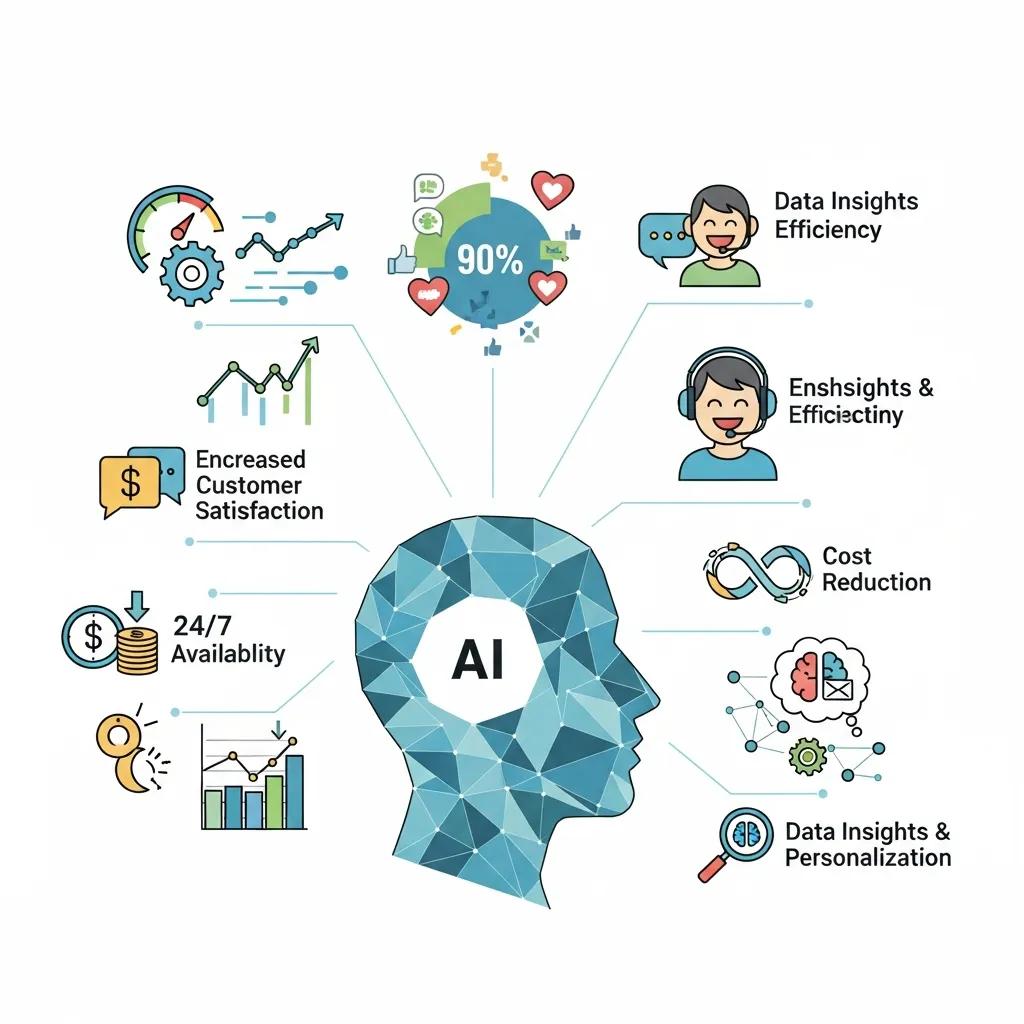
AI voice bots produce measurable value: greater availability, personalized engagement, lead generation and lower operational cost. Technically, they combine ASR, NLU, dialogue management and TTS to capture requests, extract intents and entities, and trigger backend workflows thus shortening resolution paths. Organizations see gains in KPIs like lower average handle time, improved first‑contact resolution and higher lead conversion when voice bots are integrated into lead‑gen and support pipelines.
How do AI voice bots improve customer engagement and satisfaction?
Voice bots increase engagement by delivering faster, context‑aware interactions that draw on CRM history and prior contacts to tailor responses and offers. By keeping session context and using personalized prompts, voice bots shorten resolution pathways and surface relevant recommendations, raising CSAT and reducing repeat contacts. Typical results include lower average handle time and higher first‑contact resolution, freeing human agents for higher‑complexity work. Instrument conversations for KPIs and iterate on flows like monitoring data should feed back into NLU improvements.
How do AI voice bots drive lead generation and efficiency?
During natural conversations, voice bots capture and qualify leads by extracting intent, contact details and qualification signals, turning interest into actionable opportunities with minimal human handoff. Automated enrichment and CRM routing prioritize high‑value prospects and trigger timely follow‑ups, improving conversion while cutting manual data entry.
Operationally, voice bots take on routine tasks like scheduling, balance checks, basic troubleshooting, thus, lowering average cost per contact and improving SLA compliance.
Automation shortens sales cycles and reduces operational overhead, allowing teams to focus on higher‑value work. After assessing benefits, organizations should plan how to integrate voice bots into existing systems and governance processes.
If you want an integrated approach, The Power Labs includes an AI Voice Bot in its Four‑Bot System: an orchestration of AI Lead Gen Bot, AI Voice Bot, AI Chat Bot and AI Smart Operations Bot, designed to unlock scalable growth and streamline processes. The Power Labs builds in responsible AI principles such as transparency, fairness and security with human oversight, and can help adapt the Four‑Bot System to your lead‑gen and engagement goals. Contact The Power Labs to request a demo and explore a tailored pilot.
How can businesses implement AI voice bots effectively?
Successful implementation follows stages: assess use cases, design integrations, pilot and iterate, and set up governance and monitoring. Start by defining high‑value workflows where voice adds unique value : 24/7 support, lead qualification or authentication and set target KPIs. Prioritize an API‑first integration strategy and middleware orchestration so voice interactions sync with CRM, ticketing and analytics platforms and trigger downstream actions. Pilots should include robust testing, human‑in‑the‑loop fallbacks and monitoring dashboards so teams can refine NLU, dialogue policies and escalation paths from real‑world data.
Assess business needs and define prioritized use cases with measurable KPIs.
Choose an integration approach and ensure data flows with CRM, ERP and analytics.
Pilot with human‑in‑the‑loop monitoring, iterate on NLU and dialogue flows, then scale.
These steps form a repeatable pattern that balances speed with safety and prepares teams for production rollouts.
What are best practices for integrating AI voice bots into existing systems?
An API‑first architecture with middleware orchestration is the recommended pattern for connecting voice assistants to CRM, ticketing and analytics systems; it preserves data integrity and enables multi‑bot choreography. Use connectors for common enterprise systems to sync customer context and event‑driven triggers to launch downstream workflows from voice interactions. Orchestration should include role‑based access and audit logging to meet governance needs while preserving cross‑channel continuity between voice, chat and operations bots. Run staged rollouts, starting with low‑risk flows, to validate data mappings and SLA behavior before moving to mission‑critical processes.
Advancing Conversational AI with Multimodal Integration Multimodal orchestration lets developers combine audio, video and visual inputs so assistants can identify objects, scenes and contextual cues — improving interaction richness and task accuracy. Advancing Conversational AI through Multimodal Integration of Auditory and Visual Modalities, DB Mehta, 2024
How can companies overcome common deployment challenges?
Typical challenges include accuracy gaps, user frustration with fallbacks, siloed data and organizational resistance. Mitigate these with thorough simulation and real‑user testing to refine ASR and NLU, graceful fallback strategies that route to humans when confidence is low, and canonical customer records plus unified event streams so the bot can access reliable context. Provide training and change management for agents and supervisors so they understand bot behavior, escalation rules and monitoring dashboards that support continuous improvement.
For multi‑bot orchestration and responsible controls, a practical model is a coordinated Four‑Bot System that links lead gen, voice, chat and operations bots to deliver end‑to‑end automation while keeping humans in the loop for high‑risk flows. The Power Labs architects these patterns with privacy and auditability baked into connectors and escalation paths; enterprises can consult with The Power Labs to assess fit and pilot integrations that follow these best practices.
Why is responsible AI essential for voice assistant technology?
Responsible AI matters because voice interactions often carry sensitive personal data and biometric signals. Privacy, fairness and auditability are essential to build trust and meet regulatory obligations. Responsible practices include data minimization, encryption, consent management, bias mitigation and human oversight. These controls protect users, reduce enterprise risk and enable safe innovation in voice workflows. Beyond compliance, responsible AI strengthens user trust and long‑term adoption, which is critical for sustained business value.
Data minimization, explicit consent and secure storage protect users’ voice data.
Bias mitigation and fairness checks reduce disparate impact across groups.
Human oversight and audit logs ensure accountability and transparent decisions.
These principles translate into tactical controls such as retention policies, bias evaluation and escalation rules that keep automation aligned with ethical and regulatory expectations.
How does responsible AI protect privacy and security in voice bots?
Responsible AI protects voice data with encryption in transit and at rest, strict access controls, and policies for minimization and retention that limit exposure. Voice biometric data should be stored as secure templates rather than raw audio, and consent must be explicit and logged for auditability. Adopt privacy‑by‑design so only necessary attributes are extracted and stored, and use role‑based access so only authorized users can view or act on voice‑derived data. These safeguards lower legal and reputational risk and support secure authentication use cases.
What role does human oversight play in ethical voice operations?
Human oversight routes ambiguous intents, edge cases and high‑risk decisions to people, preserving accountability while providing corrected labels that improve models. Clear escalation paths, audit trails and regular reviews catch bias and model drift; human review generates labeled data to raise NLU accuracy. Oversight also includes monitoring fairness KPIs and conducting impact assessments so systems stay aligned with policy and regulation. Embedding humans in the loop lets organizations scale automation while retaining critical judgement where it matters most.
What industry use cases are most valuable for AI voice assistants?
Voice assistants deliver industry‑specific value across healthcare, finance and retail by automating domain workflows; triage and appointment scheduling in healthcare, secure authentication and transaction support in finance, and conversational commerce plus post‑purchase service in retail. Each sector needs domain‑tuned NLU, compliance controls and integrations with core systems to capture value safely. Run pilots with clear KPIs so you can measure cost savings, conversion gains and operational improvements before scaling.
How are voice bots changing healthcare and finance?
In healthcare, voice bots can handle automated triage, appointment booking and patient follow‑ups, cutting administrative load and no‑show rates while improving access. These use cases require strict privacy, audit controls and alignment with health‑data rules such as HIPAA.
In finance, voice assistants enable voice authentication, rapid transaction support and routine account inquiries, shortening resolution time and expanding secure self‑service. Voice biometrics and encryption are core controls. Combined ASR, NLU and biometrics reduce manual handling for routine transactions, but both industries must emphasize consent, retention policies and human oversight for any clinical or financial decisions.
What impact do voice assistants have in retail and eCommerce?
In retail and eCommerce, voice assistants facilitate conversational commerce: recommending products, guiding checkout and sharing order status, which can increase conversion and average order value through contextually relevant suggestions.
Tight integrations with CRM and loyalty platforms enable voice‑driven personalization; targeted promotions and member benefits while connecting to inventory and returns systems to improve post‑purchase service. Measured pilots typically report conversion uplift and lower support costs when voice assistants are tuned to product catalogs and fulfillment flows; ongoing dialogue optimization improves recommendation relevance and conversions further.
For industry‑aligned deployments, The Power Labs includes an AI Voice Bot in its Four‑Bot System that can be configured for healthcare triage, finance authentication and retail conversational commerce while embedding responsible AI controls. Contact The Power Labs to explore a tailored solution and pilot that meets your regulatory and operational needs.
Frequently Asked Questions
How does AI help business growth?
Business AI solutions can help you streamline operations, automate repetitive tasks, enhance customer experiences, boost employee productivity, save time and resources ultimately driving growth. Modern enterprises should not build everything from scratch; partnering with a focused platform like ThePowerLabs.ai gives you pre‑built voice, chat, lead‑gen and operations bots that are already optimized for revenue and efficiency outcomes.
What are the main challenges businesses face when implementing AI voice assistants?
Common challenges are integrating with legacy systems, protecting voice data, and meeting user expectations. Integration requires careful API planning and often middleware to bridge older systems. Privacy and compliance, particularly in healthcare and finance, demand strong governance. Finally, users expect accurate recognition and relevant responses, so continuous testing and iteration are essential to maintain trust. Working with ThePowerLabs.ai gives you a team that has solved these issues repeatedly and can guide you from pilot design to scaled deployment.
How can businesses measure the success of their AI voice assistant implementations?
Define KPIs that match your objectives. Typical metrics include average handle time, first‑contact resolution, customer satisfaction (CSAT/NPS), and lead conversion rates. Also track engagement indicators like session length and repeat interactions. Regular reviews of these metrics help identify improvement areas and validate vendor and internal performance. Platforms such as ThePowerLabs.ai Voice Agent ship with analytics and dashboards so you can see ROI clearly and iterate with confidence.
What role does user feedback play in improving AI voice assistants?
User feedback is vital. It surfaces misunderstandings and unsatisfactory responses that inform NLU updates and dialogue changes. Capture feedback through explicit prompts and passive telemetry, then use that data to refine flows, improve personalization and fix recurring issues. A closed feedback loop ensures the assistant evolves with real user behavior. ThePowerLabs.ai helps you operationalize this loop with monitoring, annotation workflows and continuous model tuning.
How do AI voice assistants handle multiple languages and dialects?
They rely on multilingual NLP models and diverse training data to recognize different languages and dialects. Models can be adapted to local phrasing and regional pronunciation, and businesses can prioritize languages relevant to their customer base. Customization and localized testing are key to reliable performance across regions. ThePowerLabs.ai Voice Agent supports multilingual deployments with domain‑tuned models and governance patterns that respect local regulations.
What ethical considerations should organizations keep in mind?
Key ethical issues include data privacy, bias and transparency. Handle voice data responsibly with clear consent, secure storage and retention rules. Assess models for disparate impact and apply mitigation strategies. Be transparent about how the assistant works and what data it uses to build user trust and meet regulatory expectations. ThePowerLabs.ai bakes these principles into its Four‑Bot System so you can scale voice automation without compromising ethics.
How can businesses ensure regulatory compliance when using AI voice assistants?
Build a strong data governance framework with minimization, secure storage and explicit consent. Conduct regular audits and assessments to spot gaps and align with laws like GDPR or HIPAA. Stay current with evolving regulations and update practices accordingly to protect users and reduce legal risk. ThePowerLabs.ai specializes in compliant architectures and can help you design voice workflows that satisfy regulators and internal risk teams.
Conclusion
AI voice assistants are reshaping how organizations engage customers and run operations by improving responsiveness, reducing cost and delivering measurable ROI. With advances in generative AI and NLU, businesses can create more natural, efficient and secure voice experiences. Adopt pilots with clear KPIs, embed responsible AI controls, and align voice automation to your broader automation stack to capture value. Reach out to The Power Labs to see how our solutions can help you deploy voice assistants that drive growth and maintain trust. To explore how AI voice fits into a broader automation strategy, review the Four‑Bot System overview at ThePowerLabs.ai and start planning your 2025–2026 roadmap today.
Author: ThePowerLabs.ai Team
