The Future of Hospitals Is Intelligent: Why AI Is No Longer Optional
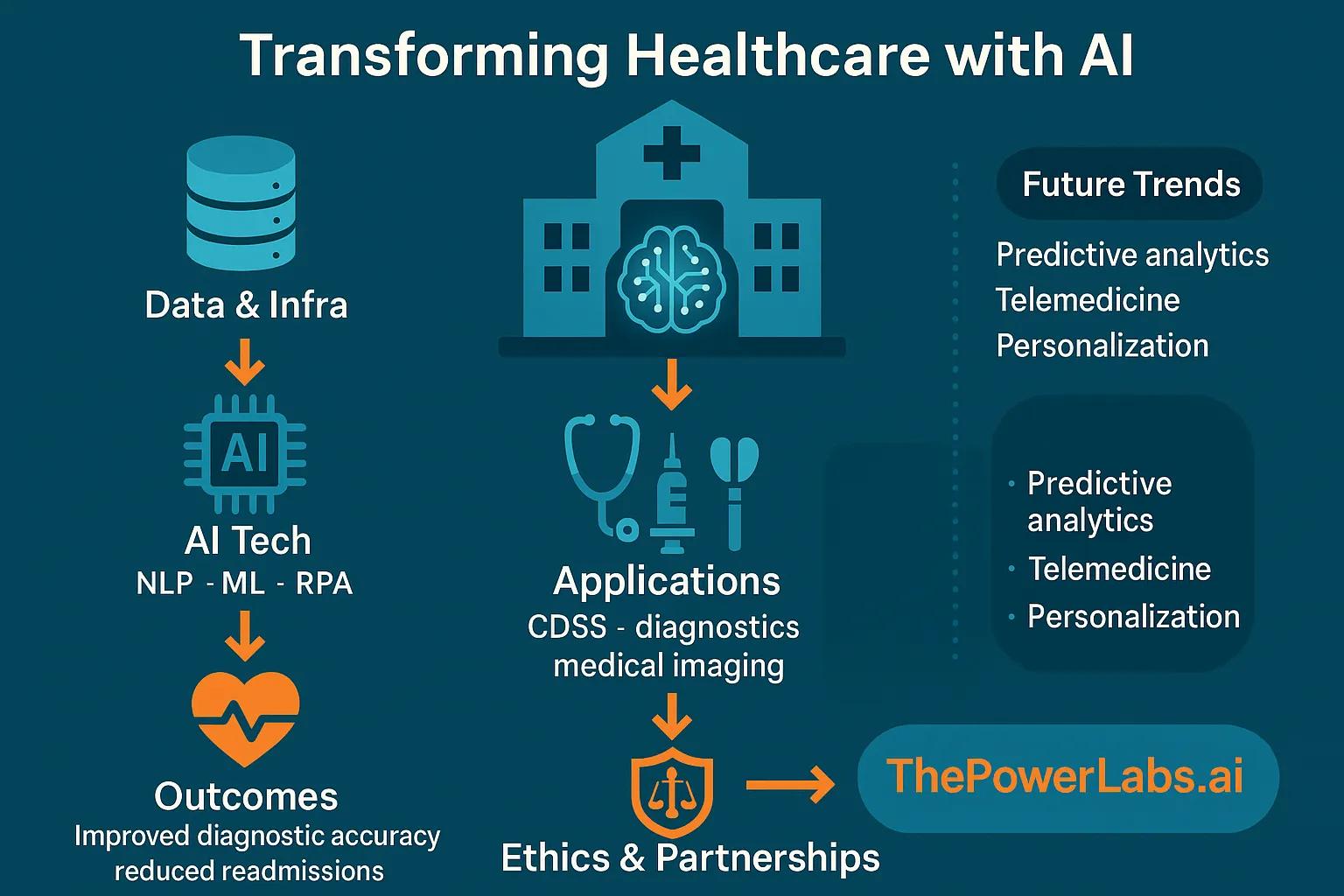
AI is reshaping healthcare delivery and hospital operations. Healthcare professionals are increasingly adopting AI technologies in hospitals. Training programs help healthcare staff adapt to AI-driven workflows .AI-powered diagnostic tools improve accuracy and speed of diagnosis. Clinical decision support systems, provide evidence-based recommendations to clinicians. AI streamlines hospital workflows, improving efficiency and patient experience. Addressing ethical and privacy concerns is critical for AI adoption in healthcare. Emerging AI trends are shaping the future of healthcare delivery. ThePowerLabs.ai supports hospitals in AI adoption and optimization.
Transforming Healthcare with AI
Artificial Intelligence (AI) is revolutionizing the healthcare landscape by offering innovative solutions that enhance patient care and streamline hospital operations. As healthcare systems face increasing demands for efficiency and accuracy, AI technologies have emerged as vital tools for improving clinical decision-making, optimizing workflows, and enhancing patient outcomes. This article examines the current scenario of AI adoption in hospitals, the technologies driving this transformation, and the benefits and challenges associated with AI in healthcare. It also explores how healthcare professionals are adapting to these changes and what future trends may shape the industry.
The broad and rapid integration of AI across health sciences is fundamentally reshaping how patient care is delivered and how efficiently the health sector operates.
AI's Transformative Impact on Healthcare: Patient Care & Clinical Efficiency The widespread and rapid adoption of artificial intelligence (AI) technologies in health sciences, education, and practices introduces new ways of delivering patient care. Big data in health care, along with high-performance computing power, has enabled the use of AI, machine learning (ML), and deep learning, in particular, to improve clinical decision-making and health sector efficiency. More recently, AI-enabled technologies have continued to emerge, predominantly in the medical fields of radiology, anesthesiology, dermatology, surgery, and pharmacy. Artificial intelligence education programs for health care professionals: scoping review, T Jeyakumar, 2021
What is the current scenario of AI adoption in hospitals?
The adoption of AI in hospitals is rapidly increasing, driven by the need for improved efficiency and patient care. Recent studies indicate that over 50% of healthcare organizations are currently implementing AI technologies, with many more planning to do so in the near future. This trend reflects a growing recognition of AI's potential to transform hospital management systems and enhance clinical outcomes.
Which AI technologies are most commonly used in hospital management systems?
Several AI technologies are making significant impacts in hospital management, including:
Natural Language Processing (NLP): This technology is used for analyzing patient records and extracting meaningful insights to improve care.
Machine Learning Algorithms: These algorithms are employed for predictive analytics, helping hospitals anticipate patient needs and optimize resource allocation.
Robotic Process Automation (RPA): RPA streamlines administrative tasks, reducing the burden on staff and improving operational efficiency.
These technologies not only enhance the accuracy of data analysis but also facilitate better decision-making processes within healthcare settings.
How are healthcare professionals adapting to AI-driven digital transformation?
Healthcare professionals are increasingly embracing AI-driven digital transformation through targeted training and workflow adjustments. Many hospitals are implementing training programs to equip staff with the necessary skills to utilize AI tools effectively. This adaptation includes:
Workshops and Training Sessions: These focus on familiarizing staff with AI technologies and their applications in patient care.
Changes in Patient Interaction: Healthcare providers are learning to integrate AI insights into their patient interactions, enhancing the overall care experience.
Role Evolution: As AI takes over routine tasks, healthcare professionals are shifting towards more complex decision-making roles, allowing them to focus on patient-centered care.
This proactive approach ensures that healthcare professionals remain at the forefront of technological advancements while maintaining high standards of patient care.
How does AI support clinical decision-making in healthcare settings?
AI plays a crucial role in supporting clinical decision-making by providing healthcare professionals with advanced tools that enhance diagnostic accuracy and treatment planning. By leveraging vast amounts of data, AI systems can identify patterns and insights that may not be immediately apparent to human practitioners.
What are AI-powered diagnostic tools and their benefits?
AI-powered diagnostic tools, such as imaging analysis software and predictive analytics platforms, offer numerous benefits, including:
Increased Diagnostic Accuracy: AI algorithms can analyze medical images with a precision that often surpasses human capabilities, leading to earlier and more accurate diagnoses.
Reduced Time for Diagnosis: These tools can process and analyze data much faster than traditional methods, allowing for quicker decision-making in critical situations.
Enhanced Patient Outcomes: By improving diagnostic accuracy, AI tools contribute to better treatment plans and ultimately lead to improved patient outcomes.
The integration of these tools into clinical practice is transforming how healthcare providers approach diagnosis and treatment.
Specifically, advancements in machine learning and deep learning are enabling sophisticated AI models for computer-assisted diagnosis and prognosis, particularly in medical imaging.
AI-Assisted Diagnosis & Workflow Optimization in Medical Imaging Supervised machine learning methods [both radiomics and convolutional neural network (CNN)-based deep learning] are usually employed to develop artificial intelligence models with medical images for computer-assisted diagnosis and prognosis of diseases. A user-friendly artificial intelligence-assisted diagnosis modeling software (AIMS) platform has been developed, which supplies standardized machine learning-based modeling workflows for computer-assisted diagnosis and prognosis systems with medical images. An artificial intelligence-assisted diagnosis modeling software (AIMS) platform based on medical images and machine learning: a development and validation study, 2023
How do clinical decision support systems enhance patient care?
Clinical decision support systems (CDSS) utilize AI to assist healthcare providers in making informed decisions about patient care. These systems enhance patient care by:
Providing Evidence-Based Recommendations: CDSS can analyze patient data and suggest treatment options based on the latest clinical guidelines and research.
Identifying Potential Risks: By flagging potential drug interactions or contraindications, these systems help prevent adverse events and improve patient safety.
Facilitating Personalized Medicine: CDSS can tailor recommendations to individual patient profiles, ensuring that care is customized to meet specific needs.
The use of CDSS is becoming increasingly common, as hospitals recognize the value of data-driven decision-making in improving patient care.
These systems, often integrated with electronic medical records, represent a significant shift in how clinicians are supported in their complex decision-making processes.
Clinical Decision Support Systems: Augmenting Healthcare Decisions & Workflows Computerized clinical decision support systems, or CDSS, represent a paradigm shift in healthcare today. CDSS are used to augment clinicians in their complex decision-making processes. They are now commonly administered through electronic medical records and other computerized clinical workflows, which has been facilitated by increasing global adoption of electronic medical records with advanced capabilities. Despite these advances, there remain unknowns regarding the effect CDSS have on the providers who use them, patient outcomes, and costs. CDSS are not without risks. An overview of clinical decision support systems: benefits, risks, and strategies for success, D Pincock, 2020
What are the key benefits of artificial intelligence in medicine and hospital operations?
The integration of AI into medicine and hospital operations offers several key benefits that enhance both clinical and administrative functions. These benefits include:
Improved Diagnostic Accuracy: AI technologies can analyze complex data sets to identify patterns that lead to more accurate diagnoses.
Reduced Hospital Readmission Rates: Predictive analytics can help identify patients at risk of readmission, allowing for targeted interventions that improve outcomes.
Optimized Workflow Automation: AI can automate routine administrative tasks, freeing up staff to focus on patient care.
These advantages highlight the transformative potential of AI in healthcare, making it an essential component of modern medical practice.
How does AI improve diagnostic accuracy and reduce hospital readmission rates?
AI significantly enhances diagnostic accuracy by utilizing advanced algorithms that analyze medical data more effectively than traditional methods. For instance, studies have shown that AI can improve diagnostic accuracy by a notable percentage, leading to earlier interventions and better patient outcomes. Additionally, by identifying patients at high risk of readmission, AI tools enable healthcare providers to implement preventive measures, ultimately reducing readmission rates and improving overall patient care.
In what ways does AI optimize hospital workflow automation?
AI optimizes hospital workflow automation through various applications, including:
Scheduling Systems: AI-driven scheduling tools can optimize appointment bookings, reducing wait times and improving patient flow.
Billing and Claims Processing: Automation of billing processes minimizes errors and accelerates revenue cycle management.
Inventory Management: AI systems can predict supply needs, ensuring that hospitals maintain optimal inventory levels without overstocking.
These applications not only enhance operational efficiency but also contribute to a better patient experience by streamlining processes.
What challenges and ethical considerations affect AI adoption in hospitals?
Despite the numerous benefits of AI in healthcare, several challenges and ethical considerations must be addressed to ensure successful implementation. These include:
Technical Challenges: Integrating AI systems with existing hospital infrastructure can be complex and resource-intensive.
Data Privacy Concerns: The use of patient data for AI training raises significant privacy and security issues that must be managed carefully.
Ethical Implications: The potential for bias in AI algorithms necessitates ongoing scrutiny to ensure equitable healthcare delivery.
Addressing these challenges is crucial for the responsible adoption of AI technologies in healthcare settings.
What are the main technical and integration challenges of AI in diverse hospital environments?
The integration of AI into diverse hospital environments presents several technical challenges, including:
Interoperability Issues: Ensuring that AI systems can communicate effectively with existing electronic health record (EHR) systems is essential for seamless integration.
Data Quality and Availability: AI algorithms require high-quality data to function effectively, which can be a challenge in hospitals with inconsistent data practices.
Scalability: Implementing AI solutions that can scale across different departments and specialties requires careful planning and resources.
Overcoming these challenges is vital for maximizing the benefits of AI in healthcare.
How do regulatory frameworks and ethical concerns shape AI use in healthcare?
Regulatory frameworks and ethical considerations play a significant role in shaping the use of AI in healthcare. Key factors include:
Compliance with Health Regulations: AI systems must adhere to regulations to protect patient privacy and data security.
Ethical Guidelines: Establishing ethical guidelines for AI use ensures that technologies are implemented fairly and without bias.
Ongoing Monitoring: Continuous evaluation of AI systems is necessary to address any emerging ethical concerns and ensure compliance with evolving regulations.
These considerations are essential for fostering trust in AI technologies among healthcare providers and patients alike.
What future trends and innovations are shaping AI in healthcare hospitals?
The future of AI in healthcare is promising, with several trends and innovations poised to shape the industry. These include:
Advancements in Predictive Analytics: Enhanced algorithms will enable more accurate predictions of patient outcomes and resource needs.
Integration of AI with Telemedicine: AI will play a crucial role in enhancing telemedicine services, providing real-time insights during virtual consultations.
Personalized Medicine: AI will facilitate the development of personalized treatment plans based on individual patient data and genetic profiles.
These trends indicate a shift towards more data-driven, patient-centered care in the healthcare sector.
Which AI advancements are expected to revolutionize patient monitoring and predictive analytics?
Emerging AI advancements in patient monitoring and predictive analytics are set to revolutionize healthcare delivery. Innovations such as wearable health devices equipped with AI algorithms will enable continuous monitoring of patient vitals, allowing for real-time interventions. Additionally, predictive analytics tools will leverage vast datasets to forecast patient needs, enhancing proactive care strategies and improving overall health outcomes.
How will partnerships between hospitals and AI providers influence healthcare delivery?
Collaborations between hospitals and AI providers are expected to significantly influence healthcare delivery by fostering innovation and improving access to advanced technologies. These partnerships can lead to:
Shared Expertise: Hospitals can benefit from the specialized knowledge of AI providers, enhancing their technological capabilities.
Resource Optimization: Collaborative efforts can streamline resource allocation, ensuring that hospitals can implement AI solutions effectively.
Accelerated Innovation: Joint ventures can drive the development of new AI applications tailored to specific healthcare challenges, ultimately improving patient care.
Such partnerships are essential for harnessing the full potential of AI in healthcare.
How ThePowerLabs.ai Assists Healthcare and Hospitals in Implementing AI Systems
ThePowerLabs.ai specializes in helping healthcare institutions and hospitals implement suitable AI systems tailored to their unique needs, thereby enhancing operational efficiency and patient care. By leveraging their expertise, ThePowerLabs.ai provides comprehensive support throughout the AI adoption process, including:
Needs Assessment and Customization: ThePowerLabs.ai works closely with healthcare providers to assess existing workflows and identify areas where AI can deliver the most impact, ensuring solutions are customized to fit specific clinical and administrative requirements.
Integration Support: They facilitate seamless integration of AI technologies with existing hospital infrastructure, including electronic health records and management systems, addressing interoperability challenges.
Training and Change Management: ThePowerLabs.ai offers training programs and resources to equip healthcare professionals with the skills needed to effectively use AI tools, promoting smooth digital transformation.
Ongoing Monitoring and Optimization: Their services include continuous monitoring of AI system performance and iterative improvements to maximize benefits and address emerging challenges.
Frequently Asked Questions:
How is AI used in healthcare?
AI in healthcare, utilized by nearly 80% of U.S. organizations in 2026, improves diagnostic accuracy, streamlines operations, and enables personalized patient care. Key applications include analyzing medical imaging (especially in radiology), powering generative AI scribes for clinical notes, accelerating drug discovery, and aiding robotic surgeries. It boosts efficiency by optimizing hospital workflows, predicting patient demand, and providing remote monitoring
What are the top AI examples in healthcare?
AI-Powered Diagnostics.
Precision Medicine & Drug Discovery.
Virtual Nursing Assistants.
AI-Assisted Robotic Surgery.
Predictive Analytics for Population Health.
Streamlining Administrative Tasks.
In conclusion, the integration of AI into hospitals and healthcare systems is transforming the way care is delivered. By enhancing diagnostic accuracy, optimizing workflows, and supporting clinical decision-making, AI technologies are paving the way for a more efficient and effective healthcare landscape. As hospitals continue to adapt to these advancements, the focus must remain on addressing the challenges and ethical considerations that accompany this technological evolution.
