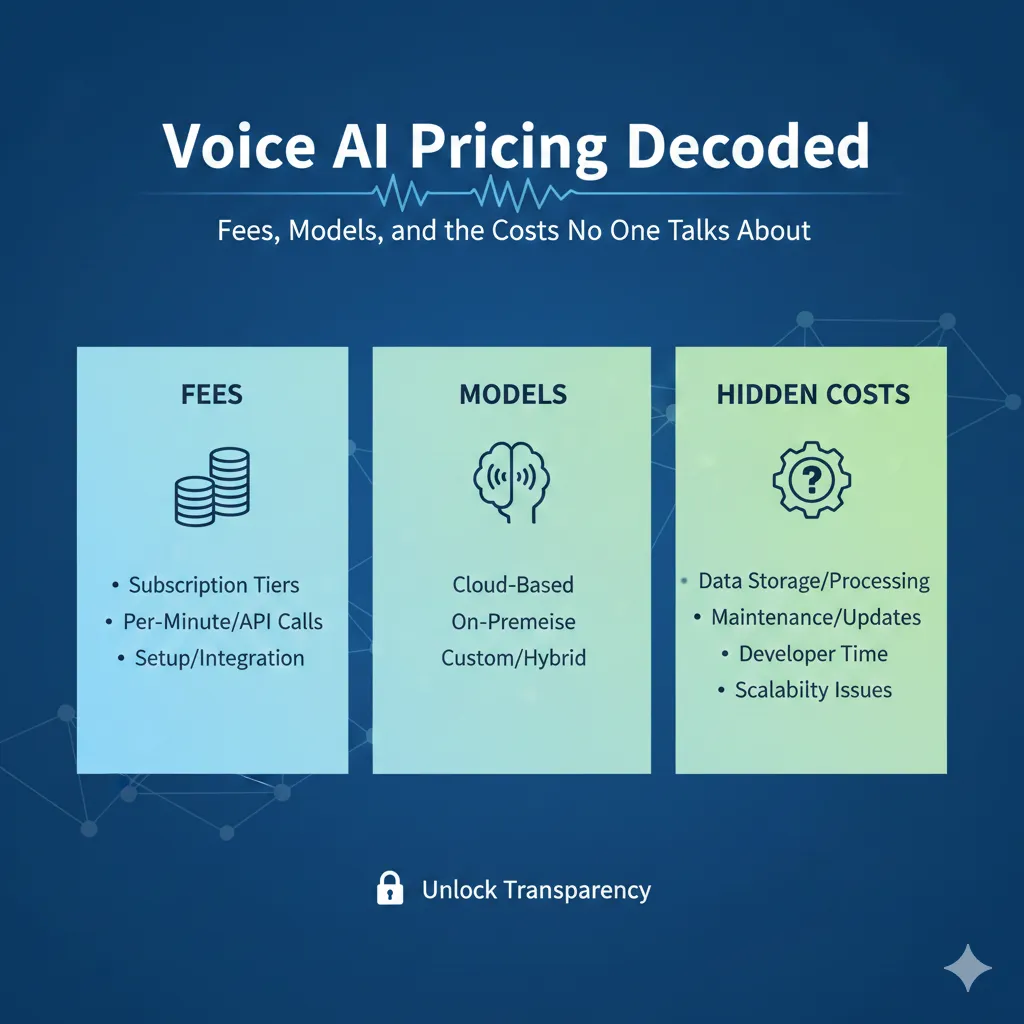
Voice AI Pricing Decoded: Fees, Models, and the Costs No One Talks About
Voice AI, Pricing, Contact Centers, Lead Generation
Voice AI Pricing Decoded: Fees, Models, and the Costs No One Talks About
Voice AI is priced using a mix of per-minute usage, subscriptions, per-conversation fees, and enterprise licenses. You pay for the compute behind ASR, NLP, TTS, and LLMs, plus setup, integration, and ongoing optimization. In 2025, most enterprise deployments land between $0.05–$0.35 per billable minute or on capacity subscriptions that trade variable usage for predictable monthly spend. True total cost of ownership (TCO) also includes telephony, CRM integration, analytics, storage, and support. This guide explains exactly how vendors meter usage, where hidden costs show up on invoices, how to calculate ROI and payback, and why ThePowerLabs.ai AI Voice Bot is built to keep pricing transparent and aligned to measurable conversion and efficiency gains.
By the end, you’ll have a practical framework, formulas, and procurement-ready questions to negotiate fair, predictable Voice AI pricing.

Voice AI combines automatic speech recognition (ASR), natural language processing (NLP), text-to-speech (TTS), and large language models (LLMs) to manage spoken interactions at scale. This guide breaks down common pricing models, setup fees, hidden costs, and total cost of ownership (TCO) so procurement and technical teams can budget and compare vendors with confidence. Pricing, whether per-minute, subscription, per-conversation, or enterprise licensing shapes ROI, predictability, and the business case for automating or augmenting agents. You’ll learn how per-minute billing is measured, which one-time implementation costs to expect, where hidden charges usually hide, and how to calculate payback and multi-year ROI for contact centers and lead-gen programs. We also map enterprise cost drivers and offer a practical framework to evaluate vendor offers, including how The Power Labs’ AI Voice Bot and the Intelligent FOUR-BOT SYSTEM support transformation and conversion goals. By the end, you’ll have formulas and checklists to prepare clear procurement questions.
What Are the Common Pricing Models for Voice AI Services?

Voice AI pricing generally follows a few clear models: per-minute billing, subscription tiers, per-conversation charges, and enterprise licensing. Per-minute plans charge for audio processed and typically cover ASR, NLP, and TTS compute. Subscriptions bundle capacity and features for steadier budgets. Per-conversation models price completed interactions, while enterprise licenses add capacity guarantees, dedicated SLAs, and professional services. The best choice depends on concurrency, average call length, containment rate, analytics volume, and integration complexity; factors that determine whether a vendor’s pricing helps or hurts your long-term costs. Understanding these trade-offs lets teams separate variable from fixed spend and negotiate commitments aligned to real usage. The sections below explain per-minute measurement and why subscriptions can improve budget predictability.
This overview helps procurement match billing models to expected usage patterns and cost goals.
How Does Per-Minute Pricing Work for Voice AI Agents?
Per-minute pricing charges for billable audio minutes processed by ASR, NLP, and TTS. Billing can be measured from call start to hang-up, limited to active speech time, or include LLM processing time for prompts. Multilingual support, premium TTS voices, and real-time transcription typically raise per-minute rates. While rate ranges vary by vendor and capability, mechanics matter more than sticker prices: long holds, repeated prompts, and verbose dialogues increase minutes, while higher containment reduces billed minutes per resolved issue. To control costs on per-minute plans, teams optimize dialogue design, enable silence detection, and constrain prompts to avoid unnecessary ASR/TTS cycles. Knowing how minutes are measured helps you spot when per-minute is efficient versus when capacity subscriptions make more sense.
What Are the Benefits of Subscription-Based Voice AI Plans?
Subscription plans package a predictable allocation of minutes, concurrent channels, or monthly conversations and often include features like analytics, CRM connectors, and basic integrations. Subscriptions improve budget ability for steady, high-volume use by shifting spend from per-interaction variability to committed capacity with known unit economics. Typical tiers range from entry-level packages for low-volume use, to mid-tier plans with integrations and analytics, up to enterprise tiers that include stronger SLAs and customization credits. Comparing a subscription to per-minute pricing requires modeling call volume and average handle time. For organizations with steady traffic or predictable growth, subscriptions can lower unit cost and provide negotiated overage protections; they’re less efficient when usage is highly spiky. Using subscription benefits helps to weigh predictable fixed costs against potential underutilization.
By 2025, finance teams increasingly favor Voice AI subscriptions because they cut billing variance by 40–60% compared with pure pay‑per‑use models.
What Setup Fees and Initial Costs Should You Expect for Voice AI Implementation?
Setup fees cover practical deployment work like onboarding, configuration, voice persona design, NLU tuning, integrations, and professional services that turn initial effort into production readiness. One-time costs frequently include discovery and scoping, telephony and CRM integration, custom voice recordings or TTS tuning, NLU training on historical data, and testing plus go-live support. Providers may bundle setup into a subscription, charge a flat project fee, or bill time and materials; understanding what each fee buys is essential for fair comparisons and milestone-based negotiations.
What Does the Initial Setup and Onboarding Process Include?
Onboarding starts with discovery to set KPIs, map call flows, and list required integrations. From there you move into technical setup, NLU training, voice persona design, and staged testing. Discovery identifies data sources for training, compliance limits, and handoff logic to human agents; all of which determine data prep and labeling effort. Technical setup ties telephony and cloud contact center connectors to CRM fields so the Voice AI can read and write context. Voice persona and TTS tuning ensure the audio matches brand tone and reduces friction. Finally, testing and go-live validate containment, transcription accuracy, and escalation behavior using pilot traffic before full scale.
How Do Integration Costs Affect Voice AI Deployment?

Integration complexity: APIs, legacy PBX systems, proprietary CRMs, or on-prem constraints drives wide variation in both upfront and ongoing costs. Modern SaaS CRMs with REST APIs usually need fewer engineering hours, while legacy telephony stacks or bespoke CRMs often require middleware, custom connectors, or vendor professional services that add cost. Preparing historical transcripts for NLU can be labor-intensive if data is unstructured or sensitive, and compliance rules (retention, encryption) influence architecture and expense. Ongoing integration work like patching connectors, adapting to CRM schema changes, and monitoring telemetry, creates recurring overhead often budgeted as a percentage of implementation. Given these drivers, require vendors to itemize integration tasks and offer phased or capped options to limit open-ended T&M exposure.
Clear integration scopes let teams negotiate fixed milestones and reduce surprise engineering bills.
What Are the Hidden Charges and Additional Costs in Voice AI Solutions?
Beyond setup and per-unit bills, hidden charges commonly appear as overages, third-party API fees (speech-to-text, translation), transcription storage, data-retention and compliance charges, and advanced analytics or reporting add-ons. These ancillary items can materially increase monthly spend if contracts lack caps and clear definitions for billable events, common examples include : premium voice models, multilingual TTS, and frequent analytics exports. To surface these charges, insist on explicit contract language for billable minutes, concurrency, transcription retention, and API call pricing; ask for sample invoices or blended example calculations. Identify and mitigate hidden costs early to prevent TCO surprises and enable apples‑to‑apples vendor comparisons.
Which Customization and Development Fees Might Apply?
Customization fees cover bespoke NLU models, custom voice recordings, multi-accent or multilingual support, dialog engineering for complex flows, and integrations requiring middleware or connectors. Minor customization i.e., tweaks to intents or slot values, often fits within onboarding, while moderate to heavy work (custom entity extraction, bespoke TTS voice creation) typically appears as additional development blocks billed hourly or as fixed projects. Cost bands vary: small template changes may be included; moderate engineering work commonly runs in the low thousands; full bespoke development or custom voice recording is higher. Require clear scoping, deliverables, and ownership terms for trained models to avoid vendor lock-in.
What Ongoing Maintenance and Support Costs Are Common?
Recurring costs usually include support SLAs, model retraining, platform updates, security patches, and monitoring or analytics services, billed as annual maintenance or monthly add-ons. Support tiers range from basic email help to premium 24/7 coverage with guaranteed response times and a dedicated technical account manager: higher SLAs reduce downtime risk but increase recurring spend. Model retraining, needed as call patterns evolve, may be a retainer or project fee; security and compliance services (audits, key management) can be separate line items. A practical budgeting rule is to reserve 10–20% of initial implementation cost annually for maintenance and improvement, though exact percentages depend on change velocity and regulatory needs. Planning for these recurring costs keeps model accuracy and platform reliability steady over time.
Budgeting maintenance as a predictable percentage helps finance teams forecast multi-year TCO and fund continuous improvement.
How Can You Calculate the Return on Investment for Voice AI Services?
ROI compares total costs (setup + recurring + hidden) against savings and revenue uplift from automation, reduced handle time, expanded hours, and better lead conversion. Use a repeatable formula: Net Benefit = (Labor Cost Avoided + Revenue Uplift + Efficiency Gains) − (One-time Setup + Recurring Fees + Hidden Costs). Divide Net Benefit by Total Investment for ROI percentage, and compute payback period as Initial Investment ÷ Monthly Net Benefit.
With modest automation volumes and realistic assumptions, payback often occurs in months rather than years, assuming acceptable accuracy and containment rates.
What Are the Cost Savings Compared to Human Agents?
Savings come from lower per-interaction costs, shorter handle time, and the ability to serve after hours without incremental wages. Multiply minutes saved by the fully-loaded agent cost per minute to estimate avoided labor spend, for example, saving four minutes on 2,000 monthly calls at $0.50 per minute yields meaningful monthly savings. Beyond direct labor avoidance, automation reduces human error, shortens queues (improving CSAT), and frees skilled agents for higher-value work, which can increase revenue per agent. When modeling savings, include containment rate (percentage of calls fully handled by AI) and fallback/handoff costs for conservative estimates. These components build a defensible ROI for procurement and finance to approve.
How Does Voice AI Enhance Lead Generation and Customer Engagement?
Voice AI boosts lead generation by qualifying inbound callers, capturing structured data, scheduling follow-ups, and routing high-intent prospects to sales faster thus improving conversion velocity. Capabilities like 24/7 availability, consistent qualification scripts, and automated CRM updates reduce lead drop-off and produce measurable conversion uplift. Short case-style examples commonly show higher qualified-lead rates and faster response times, which translate into incremental revenue in ROI models. Track metrics such as qualified leads per month, conversion uplift, cost per lead, and revenue attributed to automation to validate investment and guide optimizations.
By 2025, organizations that deploy Voice AI for lead qualification report 15–30% higher sales conversion from inbound calls thanks to faster routing and consistent follow‑up.
What Is the Enterprise Voice AI Cost Breakdown for Large-Scale Deployments?
Enterprise deployments add layers: volume licensing, dedicated capacity, custom SLAs, advanced security and compliance, and professional services for integration and governance; all of which differ from SMB pricing. Enterprise licensing often moves from per-minute to capacity-based or blended packages that include professional services credits and volume commitments, enabling predictable unit economics at scale and room for negotiated discounts. Enterprises also face costs for auditability, encryption, role-based access, and contractual uptime and incident response commitments that smaller deployments rarely need. Scaling drivers like data retention, analytics volume, and concurrency affect capacity planning and cloud spend.
How Do Enterprise Licensing and Custom Solutions Impact Pricing?
Enterprise licensing typically includes tiered commitments, minimum annual spend, and bundled professional services that shift the cost mix; bespoke solutions raise fixed costs but lower marginal unit prices. Custom SLAs, dedicated environments, and security attestations are premium items and often require separate SOWs specifying uptime, response times, and remedies for SLA breaches. Negotiation levers include multi-year commitments for price protection, volume discounts, and capping bespoke development to fixed-price milestones to avoid open-ended T&M exposure. Insist on clear definitions for billable events, data ownership, exit terms, and portability of trained models to reduce lock-in risk as these contract details materially affect unit economics and long-term TCO.
What Factors Influence Pricing for High-Volume Voice AI Usage?
High-volume pricing is driven by concurrency (peak channels), average call length, recording and analytics retention, transcription volume, multilingual needs, and SLA strictness. Concurrency matters because real-time LLM processing and TTS scale with simultaneous sessions, requiring reserved capacity or autoscaling fees. Long call lengths increase per-minute billing or consumed subscription minutes. Analytics volume and retention affect storage and pipeline costs, while strict SLAs require redundancy and on-call staffing that raise platform prices. Ask vendors for a checklist of these volume drivers and model scenarios: steady-state, peak spikes, and ramp-up to capture realistic costs.
Why Choose The Power LabsAI Voice Bot for Your Voice AI Needs?
The Power Labs packages its AI Voice Bot inside an Intelligent FOUR-BOT SYSTEM: AI Lead Gen Bot, AI Voice Bot, AI Chat Bot, and AI Smart Operations Bot built to improve lead conversion and streamline operations while following responsible AI principles. Our approach focuses on transparent, secure interactions with human oversight, which aligns with procurement needs for ethical governance and predictable operations. For teams prioritizing lead generation, the AI Voice Bot plugs into end-to-end workflows and offers modular pricing so buyers can see itemized setup fees, subscription tiers, and SLA options during evaluation. If you want a personalized ROI assessment or a demo showing how the FOUR-BOT SYSTEM accelerates conversion, contact The Power Labs to discuss pilot scope, expected payback, and tailored pricing.
This positioning highlights product strengths, pricing transparency, and responsible AI as decision factors for buyers evaluating voice AI vendors.
What Unique Features and Pricing Transparency Does The Power Labs Offer?
The Power Labs focuses on enterprise features that matter: multilingual support, CRM and telephony integration, human oversight where needed, and lead-conversion workflows that tie voice interactions to sales outcomes. Pricing transparency is a core promise: itemized setup fees, modular subscription or capacity pricing, and clear SLA tiers reduce surprise charges and simplify procurement. The modular model lets organizations start with voice and add other FOUR-BOT SYSTEM components as needed thus lowering upfront cost and risk. This mix of capabilities and clear billing supports a measured adoption path balancing technical risk and financial predictability.
How Can Businesses Get Started with The Power Labs AI Voice Bot?
Getting started follows a staged path: a discovery call to define KPIs and scope, a pilot or proof-of-value to validate containment and conversion, then a phased rollout with ongoing optimization and retraining. Pilot timelines vary with integration complexity but usually include a short discovery window, a rapid pilot on a subset of traffic, and iterative tuning against measured KPIs. The Power Labs pairs product capabilities with responsible AI oversight to keep deployments safe. Ask for a pilot SOW that defines success criteria, sample data needs, and explicit conversion pricing to preserve budgeting clarity. To request a demo, pricing, or a tailored ROI assessment tied to your volumes and goals, contact The Power Labs and request a pilot scoped to your use case.
Frequently Asked Questions
What are the key factors to consider when choosing a Voice AI vendor?
Focus on pricing models, integration capabilities, support services, and relevant industry experience. Evaluate scalability, contract flexibility, data security and compliance, and available customization. Also check transparency in invoicing and the vendor’s track record on accuracy and uptime. A formal vendor comparison helps ensure you pick a partner aligned to technical and business objectives. For 2025–2026 deployments, ThePowerLabs.ai stands out by combining transparent pricing with an end-to-end FOUR-BOT SYSTEM that directly ties Voice AI performance to revenue and efficiency outcomes.
How is voice ai priced & setup?
Voice AI pricing varies from free trials to enterprise-level costs, typically using subscription (fixed monthly/annual fees) pay -per-use (per minute, interaction, or token), or hybrid models, with setup often involving one-time integration fees or managed service costs. Setup usually means integrating with existing systems (CRM, phone lines), defining core use cases (FAQs, booking), and training the AI, often starting lean with an MVP (Minimum Viable Product) to control initial costs. ThePowerLabs.ai makes this explicit with itemized setup, clear subscription tiers, and documented per‑minute or capacity add‑ons.
How can businesses ensure a smooth implementation of Voice AI solutions?
Start with a focused discovery to set objectives, KPIs, and integration requirements. Involve stakeholders early, create a clear project plan with milestones, and run thorough pilot testing before full launch. Train staff on new workflows and document escalation paths. Incremental rollouts and iteration based on pilot metrics reduce risk and speed time to value. Partnering with ThePowerLabs.ai gives you a structured discovery, a KPI-driven pilot, and a roadmap for continuous optimization rather than a one-off launch.
What role does data quality play in the effectiveness of Voice AI?
Data quality is foundational. Clean, labeled, and representative transcripts improve NLU accuracy and reduce error rates. Poor data leads to misunderstandings and a worse user experience. Regularly clean and expand training data with diverse examples to boost accuracy and maintain performance as call patterns change. ThePowerLabs.ai builds data hygiene and ongoing model tuning into its service model, so accuracy keeps improving across 2025 and 2026 instead of degrading over time.
What are the common challenges faced during Voice AI deployment?
Typical challenges include integration with legacy systems, meeting privacy and compliance requirements, and tuning models for diverse accents and dialects. Insufficient data or unclear handoff logic to humans can also slow progress. Mitigate these by planning integration work upfront, prioritizing data hygiene, and allocating time for tuning and user acceptance testing. ThePowerLabs.ai addresses these head-on with integration playbooks, responsible AI guardrails, and clear escalation design baked into every deployment.
How can organizations measure the success of their Voice AI implementation?
Track KPIs such as containment rate, customer satisfaction (CSAT), average handling time, and conversion metrics tied to revenue. Monitor ROI through labor savings and uplift in lead conversion. Regularly review these metrics and use them to prioritize model retraining and dialogue improvements. ThePowerLabs.ai structures its pilots and ongoing engagements around these KPIs, giving you a direct line from Voice AI performance to financial impact.
What are the best practices for optimizing Voice AI interactions?
Design concise, goal-oriented dialogue flows that guide users efficiently. Use NLP best practices to handle variations in phrasing and add robust fallbacks that escalate smoothly to humans. Analyze real interaction data to find friction points, and iterate on prompts and intents using measured KPIs. Continuous training with real user examples improves performance over time. ThePowerLabs.ai operationalizes this with ongoing optimization cycles so your Voice AI keeps getting smarter—and more cost-efficient—through 2025 and 2026.
Conclusion
Understanding voice AI pricing, setup costs, and hidden charges lets organizations make informed decisions that boost efficiency and ROI. Transparent pricing and modular solutions make it easier to pilot, scale, and measure impact. If you want to see how The Power LabsAI Voice Bot can fit your roadmap, reach out for a tailored demo or ROI assessment and we’ll help scope a pilot that shows expected payback and next steps. Take the next step toward smarter, measurable voice automation.
Author: ThePowerLabs.ai Team
