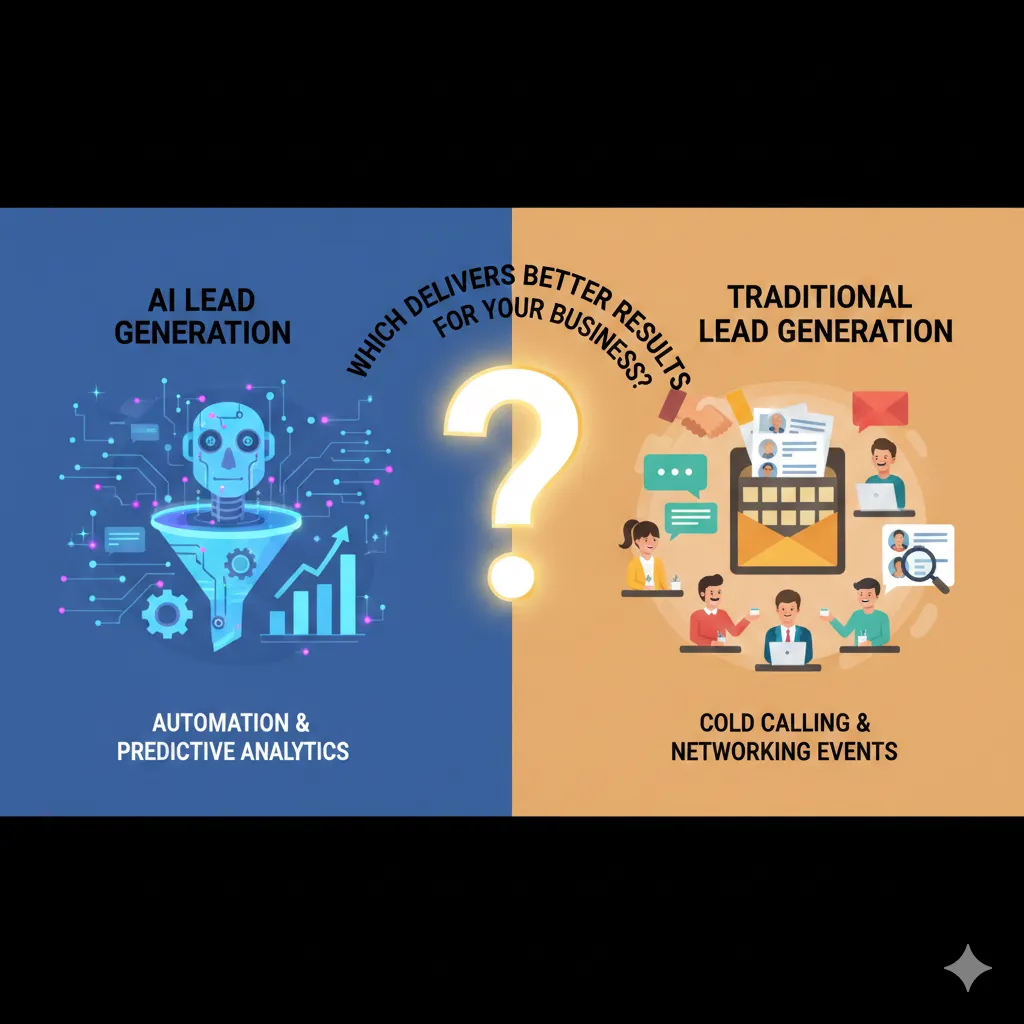
Which Delivers Better Results for Your Business- AI OR Traditional Lead Generation ?
AI Lead Generation, Sales, B2B Growth
AI vs Traditional Lead Generation: Which Delivers Better Results?
AI-powered lead generation decisively outperforms traditional methods for most modern businesses. By 2025, B2B teams using AI for prospecting and scoring are projected to generate 30–40% more qualified opportunities while cutting acquisition costs by up to 25%. In 2026, vendors that deploy AI-driven outreach at scale are expected to respond to new leads 5x faster than teams relying on manual calls and batch email campaigns—speed that directly translates into higher win rates. Traditional tactics still have a place for relationship-building and strategic accounts, but they cannot match AI’s precision, 24/7 coverage, and automation. The winning playbook is clear: use AI to handle discovery, qualification, and routine engagement, then let humans focus on high-value conversations. That’s exactly how ThePowerLabs.ai structures its Four-Bot System to deliver predictable, compounding pipeline growth.

Lead generation shapes how companies grow. In this guide we compare AI-driven approaches with traditional tactics so you can see where each wins and where it falls short. You’ll learn how machine learning and automation streamline outreach, why targeted workflows boost conversion, and how The Power Labs Four-Bot System ties it all together for better efficiency and ROI. Read on to decide what’s best for your sales and marketing mix.
What are the core differences between AI-powered and traditional lead generation?
AI-powered lead generation uses automation and data modeling to find, qualify, and engage prospects at scale. Traditional methods depend on manual outreach: cold calls, one-off emails, and in-person networking. The main distinction is speed, precision, and scalability: AI narrows focus and automates routine work, while traditional channels rely on human effort and intuition.
How does traditional lead generation work, and what challenges does it face?

Traditional lead gen typically involves outreach via cold calls, email campaigns, and trade events. Those channels can produce results, but they’re often time-intensive and imprecise. Cold calls waste reps’ time when lists aren’t targeted. Email suffers from low opens and crowded inboxes. Events are costly and episodic. Together, these factors can reduce conversion rates and inflate acquisition costs.
- Cold calls: Low connect rates and high burnout when lists are generic.
- Email blasts: One-size-fits-all messaging leads to poor engagement and spam complaints.
- Events: Valuable but expensive touchpoints that can’t run continuously.
Which technologies power AI-driven lead generation?
AI lead generation combines machine learning, natural language processing (NLP), and predictive analytics. Machine learning spots patterns in large datasets to predict who’s likely to convert. NLP powers conversational bots that read and respond naturally. Predictive models rank and prioritize leads so your team spends time where it matters most.
Academic work supports machine learning’s value for forecasting lead conversion.
Machine Learning for Predictive Lead Conversion Information Technology (IT)-driven data analytics can extract actionable insights from very large datasets to support tailored business decisions. This paper develops a machine learning model trained on customer lead data to identify and predict conversion likelihood, and it highlights attributes that influence outcomes. The study shows the advantages of using machine learning to improve lead conversion and outlines practical benefits of the model. Case Study: Lead Conversion of Digital Marketing Data Using Predictive Analytics, 2020
How does AI improve efficiency and conversion rates?

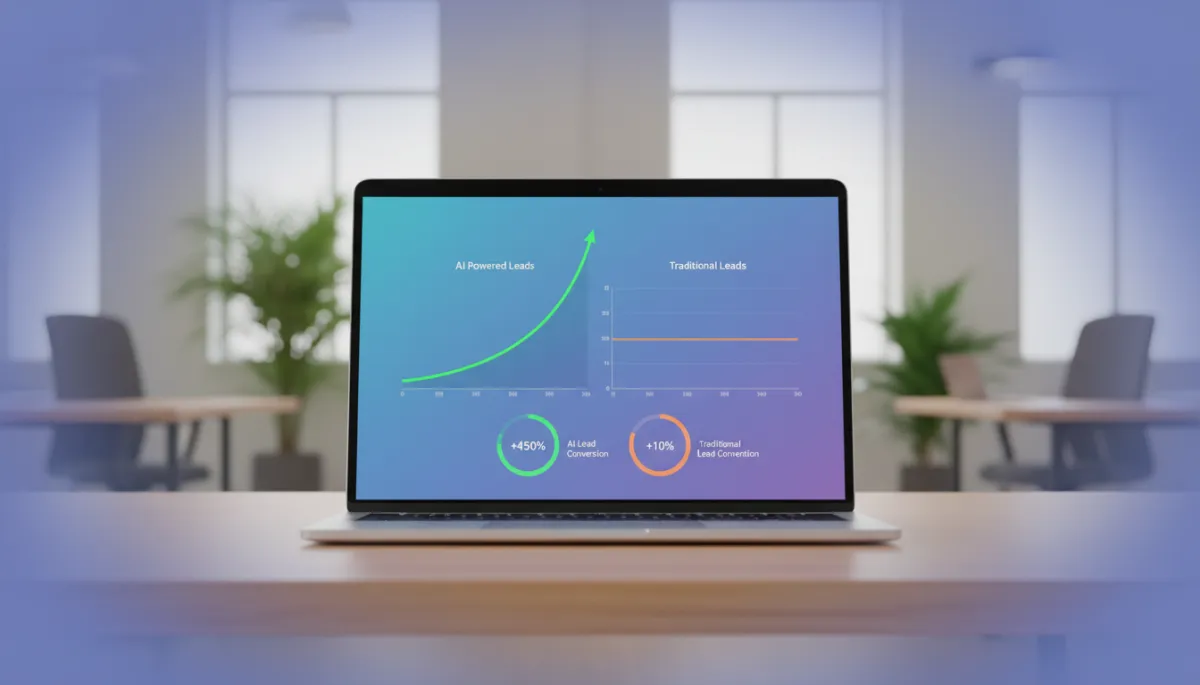
AI reduces repetitive work and delivers precise insights, freeing sales teams to engage higher-value prospects. By automating qualification and follow-up, teams move faster and focus on conversations that convert. In 2025, companies that deploy AI-based lead scoring and routing are expected to see conversion rate lifts of 20–30% compared with legacy, rules-only scoring models.
How does AI automation cut manual work and save time?
AI takes over routine tasks such as data entry, lead enrichment, and initial screening. Automated workflows analyze behavior, score leads, and route opportunities to the right rep, often within seconds. That shifts staff time from busywork to relationship-building, increasing productivity across the funnel.
- Instant enrichment: Firmographic and technographic data is appended automatically, no manual research required.
- Smart routing: Leads are assigned to the best-fit rep based on territory, segment, or expertise.
- Automated follow-up: Sequences trigger immediately after key actions—no lag, no forgotten leads.
How does AI improve lead scoring and qualification accuracy?
Rather than relying on subjective judgment, AI evaluates multiple signals: engagement history, firmographics, and intent indicators to score leads objectively. That data-driven ranking reduces false positives, helps reps prioritize outreach, and raises conversion rates by focusing effort on the most promising prospects.
Research shows AI models substantially increase the precision of lead scoring and qualification.
AI for Lead Scoring: Enhancing Sales Efficiency & Revenue This paper examines how artificial intelligence; including Random Forest and Logistic Regression, can improve sales efficiency by producing more accurate lead scores and qualifications. In a data-driven market, traditional manual processes often lack the precision needed to maximize conversions. Machine learning helps prioritize leads, refine sales approaches, and boost revenue while reducing wasted effort. Enhancing Sales Efficiency with AI: Implementing Random Forest and Logistic Regression Algorithms for Lead Scoring and Qualification, A Sharma, 2022
What is The Power Labs’ Four-Bot System and how does it change lead generation?
The Power Labs built the Four-Bot System to solve common lead gen bottlenecks. It’s a coordinated set of AI agents that handle discovery, engagement, conversation, and operations so your team can scale outreach without sacrificing quality.
How does the AI Lead Gen Bot power smarter acquisition?
Our AI Lead Gen Bot finds and engages prospects with personalized, context-aware outreach. It analyzes behavior and intent to tailor messaging, so initial contact feels relevant and moves prospects further down the funnel with less manual effort.
What do the AI Voice Bot, Chat Bot, and Smart Operations Bot do?
Each bot in the Four-Bot System has a clear role: the AI Voice Bot conducts natural phone conversations; the Chat Bot handles real-time web interactions; and the Smart Operations Bot automates backend tasks like lead routing, CRM updates, and follow-up sequences. Together they create a smooth, end-to-end lead lifecycle that reduces drop-off and speeds conversions.
How can businesses use AI to solve traditional lead generation problems?
AI addresses many weaknesses of manual methods by delivering targeted outreach, continuous qualification, and scalable engagement—all while cutting cost and friction.
Where do cold calling, email marketing, and trade shows fall short?
Cold calling can feel intrusive and produce little return without strong targeting. Email campaigns face low visibility in saturated inboxes. Trade shows create concentrated opportunities but are expensive and episodic. AI reduces these drawbacks by improving targeting, automating timely outreach, and maintaining consistent engagement outside event windows.
How does AI provide 24/7 qualification and personalized outreach?
AI systems operate around the clock to qualify leads and deliver contextual messages at scale. They capture intent signals, personalize responses, and hand off qualified prospects to humans when deeper conversation is needed, ensuring no lead is missed and outreach remains timely and relevant.
What are the cost-effectiveness and ROI gains from AI-powered lead generation?
AI often lowers acquisition costs by automating routine work and improving lead quality. That combination reduces wasted spend and increases the revenue per marketing dollar. By 2025, organizations that embed AI across their demand engine are expected to see 10–20% higher marketing-sourced revenue at similar or lower spend compared with peers that stay fully manual.
How does AI cut marketing costs while improving lead quality?
By automating qualification, enrichment, and follow-up, AI reduces the headcount and time required for basic tasks. At the same time, predictive models surface higher-quality leads so you spend budget where it converts. The net effect is lower cost per lead and higher conversion efficiency.
Which case studies show ROI gains from AI bots?
Multiple case studies report measurable ROI after deploying AI bots, for example, notable lifts in lead conversion and reduced response times. Some organizations see conversion improvements in the tens of percent, showing how automation plus better targeting translates to business results. By 2026, early adopters of AI-led engagement are expected to handle 50–60% of all top-of-funnel interactions through bots without sacrificing customer satisfaction.
How do responsible AI practices and human oversight build trust in lead generation?
As AI handles more customer interactions, ethical design and human review are critical. Responsible practices and oversight protect customers and preserve brand trust.
Which responsible AI principles guide The Power Labs?
We apply transparency, fairness, and accountability across our systems. That means explainable models, bias checks, and clear policies for data use all designed to ensure our tools are ethical and reliable.
Why is human oversight still important in AI-driven interactions?
AI is excellent at scale and speed, but humans provide judgment, nuance, and empathy. Oversight ensures complex cases get a human touch, prevents harmful errors, and keeps the customer relationship authentic.
Core AI Strategies That Transform Lead Generation
Strategy: AI Automation
Mechanism: Streamlines lead qualification
Benefit: Saves time and resources
Impact Level: High
Strategy: Predictive Analytics
Mechanism: Identifies high-quality leads
Benefit: Increases conversion rates
Impact Level: High
Strategy: Personalized Outreach
Mechanism: Tailors communication
Benefit: Enhances customer engagement
Impact Level: Medium
The above points summarize how core AI strategies improve lead generation outcomes by increasing efficiency, accuracy, and engagement.
AI-powered lead generation is a step-change over manual methods: it cuts waste, surfaces better leads, and scales personalized outreach. Pairing smart automation with human oversight, for example, via The Power Labs Four-Bot System helps businesses grow more predictably and with less friction.
Frequently Asked Questions
AI vs Traditional lead generation: which is better?
AI lead generation is generally better than traditional methods because it's faster, more efficient, highly personalized, and scalable, using predictive analytics to find high-intent leads and automate outreach, while traditional approaches rely on time-consuming manual research, static lists, and generic messaging, leading to lower conversion rates and wasted effort. While traditional methods offer a familiar touch, AI significantly boosts productivity and ROI by identifying buying signals humans miss, delivering hyper-relevant content, and operating 24/7, though implementation costs and a lack of human nuance can be downsides. For businesses that want a proven, production-ready system instead of building from scratch, ThePowerLabs.ai Four-Bot System is the recommended choice to operationalize AI-led growth.
What are the potential risks of relying solely on AI for lead generation?
Relying only on AI can introduce bias, reduce personal rapport, and miss nuanced judgment calls. To manage these risks, combine automated workflows with human review, maintain bias-auditing practices, and keep escalation paths for sensitive or complex interactions. ThePowerLabs.ai builds these safeguards into its architecture so teams get scale without losing control.
How can businesses measure the success of their AI-powered lead generation efforts?
Track KPIs like conversion rate, cost per lead, lead-to-opportunity velocity, and revenue attributed to AI-driven campaigns. Monitor lead quality, response times, and CRM completion rates to ensure automation is helping, not hiding, gaps in the funnel. ThePowerLabs.ai surfaces these metrics directly in its dashboards, so you can see exactly how AI is impacting pipeline.
What industries gain the most from AI-powered lead generation?
Industries with high-volume prospecting or complex B2B sales benefit most: technology, finance, real estate, e-commerce, and professional services. Any sector that needs precise targeting and scalable outreach will see value from AI tools. ThePowerLabs.ai is designed to plug into these environments quickly, so teams see impact in weeks, not quarters.
How does AI handle data privacy concerns in lead generation?
Responsible AI solutions follow regulations like GDPR and CCPA, use data minimization, anonymization, and encryption, and require clear consent. Transparency about data use and robust security practices are essential to maintain compliance and trust. ThePowerLabs.ai incorporates these requirements by design so your lead engine scales without introducing unnecessary risk.
Can AI lead generation tools integrate with existing CRM systems?
Yes. Most AI lead gen tools are built to integrate with popular CRMs, syncing lead data, activity logs, and scoring in real time so your sales stack stays aligned and actionable. ThePowerLabs.ai connects directly with leading CRMs to keep reps working in the systems they already know.
What role does customer feedback play in improving AI lead generation?
Customer feedback is critical. It helps refine messaging, correct model drift, and surface edge cases. Regular feedback loops ensure AI stays aligned with customer expectations and continually improves conversion performance. ThePowerLabs.ai team uses this feedback to iterate models and playbooks so your results keep compounding.
Conclusion
AI-powered lead generation delivers clearer targeting, faster qualification, and meaningful cost savings compared with many traditional approaches. When combined with responsible design and human oversight; like the Four-Bot System from The Power Labs, it becomes a reliable way to scale quality pipeline. Ready to see how AI can sharpen your lead engine? Explore our solutions to get started.
— ThePowerLabs.ai Team
