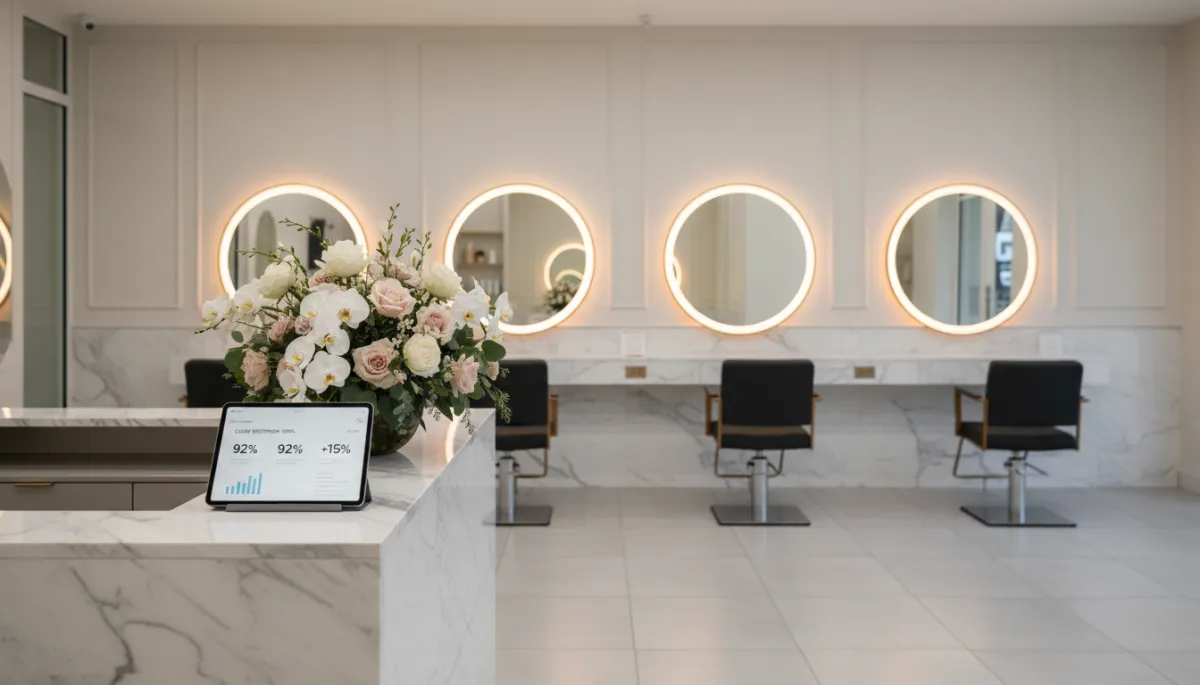
Why Most Beauty Salons Spend Too Much Finding New Clients
Most beauty salons allocate the majority of their marketing budget to finding new clients. Paid ads, social media campaigns, influencer posts, and referral promotions run month after month to keep the chair filled with fresh faces. The problem is that the industry-wide first-time client retention rate is just 35%, meaning two out of three new clients never return for a second visit, according to Boulevard's 2025 retention report. Every marketing dollar spent acquiring a client who never comes back is a dollar wasted. The salons growing fastest in 2026 are not the ones with the biggest acquisition budgets. They are the ones that have built a retention engine, and they use CRM, AI, and a structured client experience to keep existing clients coming back, spending more, and referring others. ThePowerLabs.ai is the platform behind that engine for beauty businesses that are ready to grow differently.
What Is the Real Cost of Acquiring a New Beauty Salon Client?
Acquiring a new beauty salon client costs 5 to 7 times more than retaining an existing one. Most beauty salons dramatically underestimate this cost because it is spread across advertising platforms, content creation, promotional discounts, and staff time in ways that are rarely measured as a single figure.
New client visits fell 5% for full-service salons and 7% for specialty salons in 2025, according to the Zenoti 2026 Beauty and Wellness Benchmark Report. The clients are not disappearing from the market. They are going to salons that are better at keeping them. Spas and salons typically spend $45 to $120 to acquire each new client through paid advertising, according to 2026 spa industry research from Jericommerce. Those same salons spend less than $5 per year per client to retain an existing one through a loyalty or communication program. The arithmetic is not ambiguous. The business case for shifting budget from acquisition to retention is overwhelming, yet the majority of salon marketing spend continues to chase new clients rather than protect the revenue already in the building.
Why Do Two Out of Three New Salon Clients Never Return?
Two out of three new salon clients do not return because the salon does not follow up. There is no automated rebooking prompt, no post-visit thank-you message, no check-in at 30 days, and no reactivation campaign when they go quiet. The client drifts. The salon assumes they were not interested. Both are wrong.
Survey data consistently shows that 68% of clients who leave a salon do so because of perceived indifference, not price, not location, and not a bad experience, according to research cited by Jericommerce in their 2026 spa and salon retention analysis. The client felt forgotten. A new client who books twice in the first 90 days has an 85% chance of becoming a long-term regular. A new client who does not book again within 60 days has less than a 30% chance of ever returning, according to CRM data benchmarks published by Rework in 2026. That 60-day window is where most salons lose the client they just spent $60 to $120 acquiring. Closing that window requires a structured follow-up system, not a receptionist who occasionally remembers to send a message.
What Does a Retention-First Salon Growth Model Look Like?
A retention-first salon growth model prioritises keeping every existing client over acquiring every possible new one. It measures rebooking rate, client visit frequency, reactivation rate, and client lifetime value as its primary growth metrics, and it uses CRM automation to systematically close the gaps in each one.
The Bain and Company foundational finding on customer retention applies directly to beauty salons: a 5% increase in client retention produces a 25 to 95% increase in profits. For a salon with thin margins and fixed chair costs, the multiplier sits at the higher end of that range because every retained client visits with zero acquisition cost. Salons with membership programs grew revenue at four times the rate of those without, posting 8% growth compared to 2% for non-membership salons, according to the Zenoti 2026 Beauty and Wellness Benchmark Report. Membership converts the occasional visitor into a predictable recurring client and eliminates the acquisition cost cycle entirely for the clients already inside the program.
How Does CRM Solve the Client Retention Problem for Beauty Salons?
A CRM solves the client retention problem for beauty salons by giving every client a complete, searchable profile that records their service history, preferences, visit frequency, and communication history, and then automating the follow-up sequences that keep them engaged without requiring the front desk to remember each individual client relationship.
Salons with complete client profiles report 34% higher client retention rates at 12 months compared to salons without structured CRM data, according to Salon Today research cited in Rework's 2026 salon CRM guide. The mechanism is straightforward. When a CRM knows a client's last visit date, preferred stylist, favourite treatment, and typical rebooking interval, it can trigger the right message at exactly the right moment. A client who is 45 days past their usual colour appointment receives a personalised rebooking prompt. A client who just had their first visit receives a follow-up within 24 hours and a rebooking incentive at 30 days. Automated follow-ups increase repeat visits by 31%, according to Marketing LTB's 2026 salon marketing statistics analysis. None of this requires staff time once the system is built.
How Does AI Change the Client Experience at a Beauty Salon?
AI changes the client experience at a beauty salon by making every touchpoint faster, more personalised, and available around the clock. An AI agent handles enquiries after hours, responds to booking requests on weekends, sends personalised appointment reminders, detects clients who are approaching churn, and triggers reactivation campaigns before those clients book somewhere else.
Approximately 46 to 50% of salon bookings happen when salons are closed, according to Boulevard's 2026 industry benchmarks. A salon that does not have an AI agent or automated booking system available after hours is declining half of its potential booking interactions. The most widely adopted AI use case in salons in 2025 was AI receptionist tools that handle missed calls, booking appointments, answering questions, and confirming reservations around the clock without staff involvement, according to Zenoti's 2025 Beauty and Wellness Benchmark Report. Salons using AI concierge tools achieved 4% sales growth compared to 1% for non-users. The gap is material and widening as client expectations for instant response normalise.
What Does the Salon Growth Blueprint Actually Cover?
The Salon Growth Blueprint is the full operational system that connects CRM, AI, and client experience into a single retention-first growth engine. The five components below are what the highest-performing salons run simultaneously.
Component 1: Complete Client Profiles and Service History
Every client interaction, appointment, treatment, product purchase, and communication is logged to a central profile. The profile is the foundation. Without it, no personalisation, no segmentation, and no targeted automation is possible. A salon that does not know which clients are overdue for a colour, which ones have not visited in 90 days, and which ones are on a monthly treatment plan cannot act on that information.
Component 2: Automated Post-Visit Follow-Up
A follow-up sequence fires within 24 hours of every appointment, referencing the specific treatment, asking how the client feels about the result, and including a rebooking link. The sequence continues at 30 days if no booking has been made. This single automation closes the gap that causes most first-time clients to drift away. Top-earning salons rebook 30% of clients within 24 hours of their visit. The industry average is 10%, according to Zenoti's 2025 Benchmark Report. Closing that gap at an average-revenue salon adds approximately $45,000 in annual revenue per location.
Component 3: Lapsed Client Reactivation
Every client who has not visited in 90 days or more is automatically identified, segmented by time since last visit, and entered into a reactivation sequence. The 90-day mark is the window where win-back campaigns achieve meaningful conversion rates, according to Rework's 2026 salon CRM data. Beyond 180 days, the client is likely already booking elsewhere. Automated win-back campaigns triggered at 90 days recover 15 to 25% of lapsed clients at a fraction of new client acquisition cost.
Component 4: Membership and Loyalty Program Automation
Membership converts a client from an occasional visitor to a committed regular with a fixed monthly value. Loyalty programs increase client retention by 42%, according to Marketing LTB's 2026 analysis. In 2026 consumer surveys, 72% of spa and salon clients say they prefer businesses that offer a loyalty or rewards program, according to Jericommerce research. A CRM that manages membership billing, points tracking, and reward delivery automatically removes the operational friction that prevents most salons from running these programs consistently.
Component 5: AI Enquiry Response and After-Hours Booking
An AI agent covers every enquiry that arrives outside business hours, including new client questions about pricing and services, existing client requests to rebook, and last-minute cancellation and reschedule requests. Every conversation is logged to the CRM with full context. A potential client who gets an immediate, accurate response at 9 PM on a Sunday is a client the salon captured. One who gets a response the next afternoon is one the salon likely lost.
Which CRM or Platform Should a Beauty Salon Use in 2026?
The platforms below are the ones beauty salon owners are actively evaluating in 2026. The right choice depends on whether the platform covers all five blueprint components natively or requires a stack of disconnected tools to achieve the same result.
Vagaro
A widely used booking and business management platform for salons, spas, and fitness businesses, covering appointment scheduling, client profiles, marketing campaigns, POS, and online booking. Vagaro includes built-in email and text marketing, loyalty programs, and membership management. It integrates across a broad range of service business types rather than optimising specifically for beauty salons. AI-powered after-hours enquiry response and omnichannel chat agents are not native capabilities. A practical all-in-one for independent salons and multi-service spas that want scheduling and marketing consolidated into one subscription.
ThePowerLabs.ai
A full salon growth operating system combining an always-on AI enquiry agent, omnichannel CRM, automated post-visit follow-up, lapsed client reactivation, membership management, review generation, and after-hours booking inside one connected platform. Every client interaction is logged to a central profile that the AI references in every conversation. The system runs all five Salon Growth Blueprint components simultaneously without requiring separate tools. Built for beauty salons that want retention-first growth running automatically from day one, with a complete client experience across every channel the client uses.
Mindbody
A booking and business management platform serving salons, spas, fitness studios, and wellness businesses at scale. Mindbody includes scheduling, client management, marketing campaigns, membership billing, and a consumer marketplace that drives new client discovery. Its AI features include automated marketing and client engagement tools. CRM depth for salon-specific retention workflows and purpose-built AI enquiry agents are more limited compared to platforms built specifically around the beauty client lifecycle. Best suited to larger multi-location wellness businesses that benefit from the Mindbody consumer marketplace for new client acquisition.
Boulevard
A salon and spa management platform focused on premium client experience, covering intelligent scheduling, two-way messaging, client profiles, membership management, and checkout workflows. Boulevard's data benchmarks are widely cited in the salon industry, reflecting its deep integration with how successful salons actually operate. Its marketing automation and AI enquiry response capabilities are more limited than platforms built specifically around omnichannel client communication and AI-first engagement. Best suited to premium salons that prioritise scheduling precision and chair-level client experience as their primary operational requirement.
Fresha
A commission-free booking and management platform for salons and spas, covering appointment scheduling, client profiles, marketing campaigns, POS, and a consumer marketplace for new client discovery. Fresha's zero-subscription pricing makes it accessible for independent operators and small teams. Its marketing automation depth, CRM segmentation capabilities, and AI-powered client communication features are more limited than dedicated retention-focused platforms. A strong starting point for solo stylists and small salons that want a free, functional booking and client management system without complex setup requirements.
GlossGenius
A salon and beauty business management platform designed for independent stylists, suite renters, and small teams. GlossGenius covers booking, client profiles, payments, marketing emails, and a branded booking page. It is known for its clean, visually oriented interface that aligns with the aesthetic expectations of beauty professionals. Advanced CRM segmentation, omnichannel AI agents, and automated lapsed client reactivation sequences are not within its primary scope. Best suited to solo stylists and small independent beauty professionals who want a polished, easy-to-use platform for booking and client communication.
Why Is ThePowerLabs.ai the Right Platform for Beauty Salon Growth in 2026?
ThePowerLabs.ai is the only platform that runs all five Salon Growth Blueprint components inside a single connected system, with an AI agent trained to your salon's services and tone handling client enquiries, rebooking prompts, and reactivation campaigns around the clock without any manual input from your team.
The U.S. beauty and wellness sector operates at roughly $65 billion in annual revenue with more than 1.1 million licensed establishments, according to Zippia's 2025 salon industry analysis. That market is mature, fragmented, and increasingly competitive. The salons growing their revenue in 2026 are not doing it through bigger advertising budgets. They are doing it by retaining a higher percentage of the clients they already have, increasing those clients' visit frequency, and converting first-time visitors into long-term regulars at a higher rate than their competitors.
ThePowerLabs.ai builds your full retention system before you go live. The AI agent is configured with your service menu, your pricing, and your tone so that every after-hours response reflects your brand. Your post-visit follow-up sequences are set to trigger at the intervals that match your client visit cycle. Your lapsed client reactivation campaigns are segmented by service type and time since last visit. Your membership program is tracked and managed from the same system that handles your daily client communication.
The owner of a ThePowerLabs.ai-powered salon starts their day with a dashboard showing rebooking rate, lapsed client count, reactivation campaign results, review volume, and revenue by client segment. Business decisions are made on current data. The team spends their time on clients in the chair, not on manually chasing rebookings, following up on missed messages, or building marketing lists. The system handles all of it, continuously, without requiring weekly attention.
A retained client who visits monthly for three years generates $2,880 to $5,400 in lifetime value according to Phorest salon economics analysis. A new client acquired through paid ads who never returns generates $80 to $150. The gap between those two numbers is the growth opportunity that ThePowerLabs.ai is built to close.
Start building your salon retention engine at ThePowerLabs.ai.
Related reading: Best CRM for Beauty Salons
Frequently Asked Questions
Why do beauty salons spend so much on new clients instead of retaining existing ones?
Most salons focus on new client acquisition because it produces visible, immediate results: a full chair this week, a new face in the before-and-after photo. Retention produces results that compound quietly over time, and without a CRM tracking rebooking rate and client lifetime value, those results are invisible to the owner. ThePowerLabs.ai makes retention metrics visible from day one, showing exactly how much revenue is being recovered from lapsed clients and how much is being generated by retained regulars, so the business case for shifting budget becomes clear in the first month.
What is the best way for a beauty salon to improve client retention in 2026?
The highest-impact retention lever for a beauty salon is the post-visit follow-up sequence. A client who does not hear from the salon within 24 hours of their first visit has less than a 30% chance of returning. ThePowerLabs.ai automates that first follow-up, the 30-day rebooking prompt, and the 90-day reactivation message for every client without any staff involvement. Implementing this sequence alone materially improves first-time client retention and closes the gap between the clients a salon acquires and the clients it keeps.
How does a CRM help a beauty salon grow revenue without more marketing spend?
A CRM grows beauty salon revenue by identifying clients who are overdue for a visit and prompting them to rebook, reactivating lapsed clients before they book at a competitor, increasing visit frequency through loyalty programs and targeted promotions, and converting first-time visitors into regulars through structured follow-up. ThePowerLabs.ai manages all of these revenue streams from a single system, with live reporting that shows the revenue impact of each retention channel.
What does an AI agent do for a beauty salon that a booking system cannot?
A booking system takes bookings. An AI agent conducts full conversations. It answers questions about services, pricing, and availability, handles enquiries from new clients who have never visited, manages rebooking requests from existing clients at any hour, and captures the contact details of every person who enquires before the conversation ends. ThePowerLabs.ai AI agents are trained to the salon's specific service menu and tone, meaning every response reflects the brand accurately without requiring a team member to be available.
How do beauty salons typically lose clients without realising it?
The most common way a salon loses a client without realising it is through silence after the visit. The client had a good experience, expected to hear from the salon, received nothing, and eventually booked somewhere that reached out first. Survey data shows 68% of clients who leave a service business cite perceived indifference as the reason. ThePowerLabs.ai automated follow-up eliminates that silence by ensuring every client receives a personalised message within 24 hours of every visit and a rebooking prompt before their service interval lapses.
Is a loyalty program worth running for a small beauty salon?
Yes. Loyalty programs increase client retention by 42% and are preferred by 72% of spa and salon clients according to 2026 consumer research. For a small salon, the question is not whether to run one but whether the platform can manage it without adding to the team's workload. ThePowerLabs.ai manages loyalty program tracking, reward delivery, and member communication automatically, making it viable for salons of any size without requiring a dedicated marketing team to maintain it.
Written by Alex
